What Could Have Been Done More?

Today’s Passage – Isaiah 5 – 8 (Click on the references to listen to the audio – click here to view the text from the Blue Letter Bible website)
(Second Milers also read – Luke 17 – 18; Psalms 146 – 150; Proverbs 31)
Listen to this morning’s Scripture song – Deuteronomy 32:4
Read the “0731 Evening and Morning” devotion for today, by the late Charles Haddon Spurgeon.
“What could have been done more to my vineyard, that I have not done in it? wherefore, when I looked that it should bring forth grapes, brought it forth wild grapes? … For the vineyard of the LORD of hosts is the house of Israel, and the men of Judah his pleasant plant: and he looked for judgment, but behold oppression; for righteousness, but behold a cry.” (Isaiah 5:4, 7)
Our church has a lot of property, most of which is undeveloped. Many years ago now, a couple from our church asked if they could use a small patch of that land to plant a community garden. At first I was a little hesitant, but I agreed to let these folks plant their little garden as long as it didn’t cost the church too much money, and as long as it didn’t require any extra work from me. I had to admit, I was fascinated watching the whole process, from the cultivation of the ground to the actual planting. In the years we had that garden, we actually reaped quite a bit of vegetables. Personally, I was a big fan of the little cherry tomatoes and so was my grandson, Jaxon. Whenever he was at the church, we always walked back to the garden to eat a few. One day, I was out in the garden with one of the men and he noticed a rather large green caterpillar on one of the tomato plants, very similar to the one pictured above. After careful inspection, he discovered another one on another plant. If left unchecked these pests would have completely consumed all of the plant and our little garden would have been ruined.
In our text today, we read about God’s vineyard, the Nation of Israel. God found his vineyard in ruins, and He asked the question: “What could have been done more to my vineyard, that I have not done in it?” That is a good question. What more could God have done? He gave them everything that they needed to thrive as a nation, and for a while, they did just that; but eventually sin, like those nasty caterpillars, crept in and destroyed the vineyard.
Though this passage is written for and about Israel, I believe that there are some great principles here that we can apply today. I believe applications can be made to our individual Christian lives and also to our families, and even to the local churches. Each one of these areas are a type of vineyard that belongs to the Lord. What can we do with all that God has given us in order to thrive and produce the fruit that God wants to produce through us?
1 We must use good seed. God has given us the Word of God. Why would we want to use the corruptible seed of man’s philosophies. Years ago, I made the decision that my life was going to be established with and directed by the Bible.
2 We must weed. Weeds and pests will overtake the gardens of our lives if we allow them to. In our Christian walk, many distraction can creep in, along with sinful things and false doctrines that will steal all of our energy and redirect our focus so that we cannot produce healthy fruit.
3 We must feed. Good nutrients and plenty of water will cause a garden to thrive. As Christians, we must feed daily on the Word of God, and in our churches, we must make sure that we are providing plenyt of opportunities for church members to come and dine on a healthy diet of Bible doctrine.
If God’s vineyard fails today, it will not be His fault. He has given us all that we need to thrive and produce abundant, healthy fruit.
Posted in Thoughts from Isaiah by Phil Erickson with 2 comments.
Come Now, and Let Us Reason Together

Today’s Passage – Isaiah 1 – 4 (Click on the references to listen to the audio – click here to view the text from the Blue Letter Bible website)
(Second Milers also read – Luke 15 – 16; Psalms 141 – 145; Proverbs 30)
Listen to this morning’s Scripture song – 1 John 4:7 & 8
Read the “0730 Evening and Morning” devotion for today, by the late Charles Haddon Spurgeon.
“18 Come now, and let us reason together, saith the LORD: though your sins be as scarlet, they shall be as white as snow; though they be red like crimson, they shall be as wool. 19 If ye be willing and obedient, ye shall eat the good of the land: 20 But if ye refuse and rebel, ye shall be devoured with the sword: for the mouth of the LORD hath spoken it.” (Isaiah 1:18-20)
“I, even I, am he that blotteth out thy transgressions for mine own sake, and will not remember thy sins.” (Isaiah 43:25)
“As far as the east is from the west, so far hath he removed our transgressions from us.” (Psalm 103:12)
“And they shall teach no more every man his neighbour, and every man his brother, saying, Know the LORD: for they shall all know me, from the least of them unto the greatest of them, saith the LORD: for I will forgive their iniquity, and I will remember their sin no more.” (Jeremiah 31:34)
“I write unto you, little children, because your sins are forgiven you for his name’s sake.” (1 John 2:12)
The hymn writer James Nicholson wrote:
Whiter than snow, yes, whiter than snow,
Now wash me, and I shall be whiter than snow.
It is such a blessing to know that your sins are forgiven. The passage in Isaiah was written to the southern kingdom of Judah sometime during the life of the prophet who prophesied during the reigns of kings Uzziah, Jotham, Ahaz, and Hezekiah (Isaiah 1:1), from approximately 740 BC to 680 BC. Isaiah was warning Judah about the consequences that would surely come to them, as it did to the northern kingdom, if they did not repent and turn back to God. He promises them if they “be willing and obedient” God will forgive them and prosper them once again as a nation.
Though these verses were written to the people of Judah corporately, we often apply them individually to believers today. God forgives us if we repent of our sin and turn to the Lord Jesus Christ for salvation. Forgiveness is only possible through the blood of the Lord Jesus Christ. The wrath that we deserved was poured out upon Him. However, God goes beyond just forgiving us: He forgets our sins as well. To forgive is one thing, but to forget is another level entirely. The phrase “blotteth out” (Isaiah 43:25) has the idea that the record of our sin has been completely expunged (removed).
Now let’s try to apply this wonderful attribute of God to our own relationships. We are supposed to be like God, aren’t we? If we are saved, we are being conformed to the image of Christ and we have God on the inside of us transforming us to be like Him. If all that be true, then we should be able to forget like God forgets. We say that we forgive someone who has wronged us, but we often replay mentally (or re-tell verbally) the act that was committed against us. In other words, the act has not been blotted out completely in our minds. We store the thing that was forgiven in a special compartment where we can retrieve it again in case we need it. We often pull it back out when a new violation is committed. We are keeping score in our minds. God does not do this. He removes the record altogether. Real forgiveness will lead us to blot out the act altogether; not that their will be no consciousness of the act; but it will not be allowed to be dredged back up again for some future judgment against the offender.
I have one more thought. God not only forgives sin and erases the record, but He also refuses to record any future violations. It is like getting a completely free pass from the penalty of your sins. Don’t believe me?
“But to him that worketh not, but believeth on him that justifieth the ungodly, his faith is counted for righteousness. Even as David also describeth the blessedness of the man, unto whom God imputeth righteousness without works, Saying, Blessed are they whose iniquities are forgiven, and whose sins are covered. Blessed is the man to whom the Lord will not impute sin.” – (Romans 4:5-8)
Oh that we could be more like Him: forgiving, forgetting, and even determining that we will not hold against someone any future acts committed against us. We like to be the receiver of such treatment, but we struggle to treat others in this manner.
God, help us to be more like you. Help us to love people like you do. Help us to truly accept the forgiveness that you offer us, and then help us to return the favor to someone else.
Perhaps as you are reading this, God has put someone in your mind that you are harboring unforgiveness toward. Why not determine to take that person out of your heart’s prison by giving them the forgiveness that God has given you. It is reasonable for us who are forgiven to treat others as God has treated us.
“And be ye kind one to another, tenderhearted, forgiving one another, even as God for Christ’s sake hath forgiven you.” – (Ephesians 4:32)
Posted in Devotions by Phil Erickson with 1 comment.
Without Spot

Today’s Passage – Song of Solomon 5 – 8 (Click on the references to listen to the audio – click here to view the text from the Blue Letter Bible website)
(Second Milers also read – Luke 13 – 14; Psalms 136 – 140; Proverbs 29)
Listen to this morning’s Scripture song – 1 John 3:1
Read the “0729 Evening and Morning” devotion for today, by the late Charles Haddon Spurgeon.
“How fair and how pleasant art thou, O love, for delights!” – (Song of Solomon 7:6)
“Thou art all fair, my love; there is no spot in thee.” (Song of Solomon 4:7)
“For I am jealous over you with godly jealousy: for I have espoused you to one husband, that I may present you as a chaste virgin to Christ.” (2 Corinthians 11:2)
“That he might present it to himself a glorious church, not having spot, or wrinkle, or any such thing; but that it should be holy and without blemish.” (Ephesians 5:27)
The Song of Solomon is a beautiful song written through the pen of Solomon. On the surface it would seem that this song represents a dialogue between Solomon and his wife; but considering he had 1000 wives and concubines, we would certainly be left wondering which wife this song refers to. This song then must go much deeper than any earthly relationship. I believe that the intimate relationship so beautifully detailed here is the relationship between Christ and His bride, the Church. Keeping that in mind, consider the little phrase in chapter 4 where the bridegroom says of the bride, there is no spot in thee. This is an amazing statement, because in reality there certainly are many flaws in any person; but the amazing thing is that this Man sees no flaw at all in His bride.
When I think about the unconditional love that Christ has for His Church (the Bride), and me in particular, I am blown away. How can he possibly love me? When I think about how spotted and flawed I am, I recognize my complete and total unworthiness. The only thing that I deserve is judgment: yet He loves me; and more than that: He does not see any flaw in me at all. Mind boggling! I guess that is what Romans 3:22 meant when it said that believers receive the righteousness of God. He sees me as completely righteous; flawless. Amazing!
God has given me two practical thoughts while I contemplated this passage:
1 Do I appreciate Him – I know I am totally undeserving, yet He treats as if I am. This should cause me to live my life in surrender to whatever He wants from me. This should completely humble me. The Bible tells us that the love of Christ constrains us. I have often thought that was speaking about our love for Him, but the more I think about it, the more I realize that it is His love for us that constrains us.
2 Do I appreciate others – If I am undeserving, yet accepted unconditionally; why then do I have such a hard time unconditionally accepting others, especially those that are a part of His bride as I am? Why do I see everyone else’s flaws. Should not I try to see others as Christ sees me?
Posted in Thoughts from Song of Solomon by Phil Erickson with 5 comments.
A Wonderful Story of Love

Today’s Passage – Song of Solomon 1 – 4 (Click on the references to listen to the audio – click here to view the text from the Blue Letter Bible website)
(Second Milers also read – Luke 11 – 12; Psalms 131 – 135; Proverbs 28)
Listen to this morning’s Scripture song – James 4:10
Read the “0728 Evening and Morning” devotion for today, by the late Charles Haddon Spurgeon.
“He brought me to the banqueting house, and his banner over me was love.” – (Song of Songs 2:4)
I must confess that I would rather write about a subject this morning that I have a better understanding of. The Song of Solomon is a wonderful account of love and marriage, but I really do not comprehend all that is contained in this beautiful story. I know that there is a literal, earthly story here about the love between a husband and a wife. It is clear from the passage that Solomon is the husband; but trying to figure out the identity of the wife with certainty is rather difficult as we know that Solomon had 700 of them (and 300 additional concubines). It is thought by some that this beautiful woman is Abishag, the woman who ministered to Solomon’s father in the last days of his life. We know that she was a Shulamite woman (6:13). At any rate, she is obviously Solomon’s first wife, before he had sinned by marrying so many other women.
The broader implication of this book is that Solomon is a type or picture of the Lord Jesus Christ; and his bride is a picture of the Church. It was a strange thought for me when I first learned that I was part of the Bride of Christ. I guess the man in me rebels against the feminine identity; but as I have grown through the years I have learned to accept and even somewhat understand the meaning of it all. I do love my Lord Jesus. I want to grow and learn to love Him more, but in order to do so I must learn to love myself a lot less.
As I said in the beginning of this thought, I don’t understand all that this love story has to tell us; but I love the story nonetheless from both an earthly perspective, and from the spiritual picture that it represents.
Posted in Thoughts from Song of Solomon by Phil Erickson with 3 comments.
Sharpen Your Ax

Today’s Passage – Ecclesiastes 9 – 12 (Click on the references to listen to the audio – click here to view the text from the Blue Letter Bible website)
(Second Milers also read – Luke 9 – 10; Psalms 126 – 130; Proverbs 27)
Listen to this morning’s Scripture song – 1 Timothy 1:17
Read the “0727 Evening and Morning” devotion for today, by the late Charles Haddon Spurgeon.
“If the iron be blunt, and he do not whet the edge, then must he put to more strength: but wisdom is profitable to direct.” – (Ecclesiastes 10:10)
I have been enjoying this devotional reading of the Book of Ecclesiastes as there are so many nuggets of truth. I actually had a hard time deciding what to post this this morning. I had considered doing something on Ecclesiastes 9:11, or 10:1. A couple of years back, I wrote “The Bottom Line”, from chapter 12. The verse above, however, is one of the most helpful truths in the Bible for me. You see, I am not the sharpest ax in the shed, and I need to be sharpened constantly in order to do what God has called me to do.
Solomon says that if a man does not “whet the edge”, he will have to add a little strength in order to be able to accomplish the goal. Whetting (or sharpening) the edge allowed the blade to penetrate deeper into the wood with less strength. It helps accomplish the goal without as much effort. Solomon is using this illustration to teach us about life. At the end of the verse he says that wisdom is profitable to direct. Acquiring wisdom is like sharpening the axe or whetting the edge. It will help you do the job with less difficulty.
God has given us a lot of things to do in life. In order to accomplish the things that the Lord has for us, we will need to acquire some wisdom. Wisdom makes us more proficient and helps us to accomplish the tasks at hand. God says that He will give us the wisdom that we need if we simply ask for it in faith.
“If any of you lack wisdom, let him ask of God, that giveth to all men liberally, and upbraideth not; and it shall be given him.” – (James 1:5)
We can get God’s wisdom from the Word of God, through prayer, and from the counsel of those who are wise.
I do not think that God is minimizing or belittling the value of hard work, either. There are a lot of things that I find myself doing where I am perhaps not as wise as someone else. In these situations I will have to work a little harder than that person but I can still accomplish the goal. However, if I am going to be the best that I can be at all that God has given me to do, I will need to ask for wisdom. I need His wisdom to be a good husband and father. I need wisdom in order to pastor the people of God at the church. I need wisdom for every task that I perform, and so do you. Work hard, but if you want to get the most out of each swing, you will want to sharpen your axe.
Posted in Thoughts from Ecclesiastes by Phil Erickson with 2 comments.
The Saturday Morning Post – Don’t Lose Your Head
Today’s Passage – Ecclesiastes 5 – 8 (Click on the references to listen to the audio – click here to view the text from the Blue Letter Bible website)
(Second Milers also read – Luke 7 – 8; Psalms 120 – 125; Proverbs 26)
Read the “0726 Evening and Morning” devotion for today, by the late Charles Haddon Spurgeon.
“Consider the work of God: for who can make that straight, which he hath made crooked?” (Ecclesiastes 7:13)
“And at the end of the days I Nebuchadnezzar lifted up mine eyes unto heaven, and mine understanding returned unto me, and I blessed the most High, and I praised and honoured him that liveth for ever, whose dominion is an everlasting dominion, and his kingdom is from generation to generation: And all the inhabitants of the earth are reputed as nothing: and he doeth according to his will in the army of heaven, and among the inhabitants of the earth: and none can stay his hand, or say unto him, What doest thou?” (Daniel 4:34-35)
“For I am the LORD: I will speak, and the word that I shall speak shall come to pass; it shall be no more prolonged: for in your days, O rebellious house, will I say the word, and will perform it, saith the Lord GOD.” (Ecclesiastes 12:25)
Good morning. Did you wake up this morning? Good. It’s all part of God’s perfect plan. Everything goes according to God’s plan. If He wants something to be crooked, it is crooked; and remains crooked until He makes it straight again: but we ourselves cannot make the crooked straight (see Ecclesiastes 7:13). God is sovereign: He does everything according to His will (see Daniel 4:34-35). And whatever He says He will do, He will do (see Ecclesiastes 12:25). This is why we can trust in God’s Word: He will perform it.
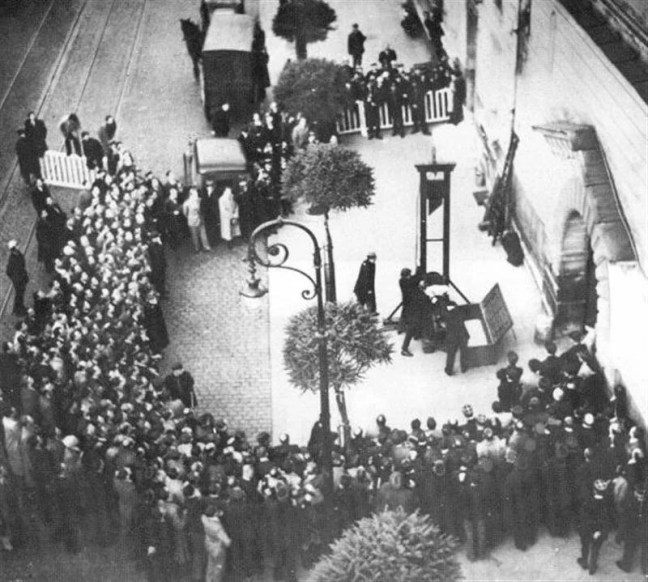
There are may prophecies given in the Word of God. One in particular, I got from NBC news. Back in 2014 there were two executions that took place within two weeks of each other. The first was a convict in Ohio. The doctors shot the two deadly chemicals into the man’s arm. Halfway through the procedure, he woke up screaming in agony. It took that convicted murderer a half-hour to die. A few days later, another execution was about to take place in Arizona. The convict was injected with the same two drugs used in the Ohio execution. after a few minutes, his body started to convulse. This time it took over two hours for that man to die. People protested the use of lethal drugs for executions, other’s were glad he suffered and suggested that Drano be used. As I read through the article, I clicked on a link. There in big bold letters was the headline I knew we would see one day…
Appeals Judge Says Guillotine ‘Probably Best’ for Executions By Tracy Connor
When you think of all the ways we have to execute people, the Guillotine seems to be the most humane. It would also fit in with God’s plan for those saved during the tribulation period…
“And I saw thrones, and they sat upon them, and judgment was given unto them: and I saw the souls of them that were beheaded for the witness of Jesus, and for the word of God, and which had not worshipped the beast, neither his image, neither had received his mark upon their foreheads, or in their hands; and they lived and reigned with Christ a thousand years.” (Revelation 20:4)
God’s plan, and purpose: He will preform it.
Peace.
Posted in Devotions by Pastor Ted Stahl with no comments yet.
All Is Vanity

Today’s Passage – Ecclesiastes 1 – 4 (Click on the references to listen to the audio – click here to view the text from the Blue Letter Bible website)
(Second Milers also read – Luke 5 – 6; Psalm 119; Proverbs 25)
Listen to this morning’s Scripture song – Ephesians 4:32
Read the “0725 Evening and Morning” devotion for today, by the late Charles Haddon Spurgeon.
“Vanity of vanities, saith the Preacher, vanity of vanities; all is vanity.” – (Ecclesiastes 1:2)
A few years back I preached a series of messages through the Book of Ecclesiastes at our church, so I have had the advantage of giving these passages a little more thought than perhaps I would normally give one of our morning devotions. As I have told our church many times, there are three keys to understanding the Book of Ecclesiastes:
1 There is a key word – “vanity” – It literally means vapor or breath. It means emptiness. James said that our lives were like a vapour.
“Whereas ye know not what shall be on the morrow. For what is your life? It is even a vapour, that appeareth for a little time, and then vanisheth away.” – (James 4:14)
This key word appears 27 times in the Book. It carries with it the idea that much of what this life has to offer ultimately is empty in itself, or will lead to emptiness. God wants us to have an abundant, fulfilling life.
2 There is a key phrase – “under the sun” – This phrase appears 33 times in the Book. It speaks of the things that are of this earth. Things that are temporary in nature, not eternal. Things that are “under the sun” are not necesarily evil things, they are just things that will be forgotten, and are without eternal value.
3 There is a key verse:
“Let us hear the conclusion of the whole matter: Fear God, and keep his commandments: for this is the whole duty of man.” – (Ecclesiastes 12:13)
Solomon came to the conclusion that much of what is done by man “under the sun” are things that are in themselves “vanity”: they produce emptiness. Therefore, we should devote as much time and energy as possible to the things that are eternal: things that will last forever. Fearing God and keeping His commandments are the highest order of business for the child of God today. Though it is certainly not wrong to enjoy the lawful things of this earth, it is important for us to keep in mind that they are temporary, not eternal; so our primary focus should be on eternity – living for the Lord.
One more thing. It might help us to remember that the human author of this book is Solomon, a man who experienced everything that this world had to offer. He had wisdom, wealth, works, and lots of women; but none of those things brought any lasting value. Only the things that were done for the Lord followed him into eternity.
Posted in Thoughts from Ecclesiastes by Phil Erickson with no comments yet.
Get the Vision

Today’s Passage – Proverbs 28 – 31 (Click on the references to listen to the audio – click here to view the text from the Blue Letter Bible website)
(Second Milers also read – Luke 3 – 4; Psalms 116 – 118; Proverbs 24)
Listen to this morning’s Scripture song – Matthew 6:33
Read the “0724 Evening and Morning” devotion for today, by the late Charles Haddon Spurgeon.
“Where there is no vision, the people perish: but he that keepeth the law, happy is he.” (Proverbs 29:18)
“And the child Samuel ministered unto the LORD before Eli. And the word of the LORD was precious in those days; there was no open vision.” (1Samuel 3:1)
If you have been a Christian for any length of time then you have most likely heard a sermon preached on vision. Most of the time the preacher will use Proverbs 29:18 to prove that the pastor and people need to have some type of plan for the future in order for the church to survive and thrive in the next generation. For instance, I have heard this verse used by a preacher who was trying to convince the congregation regarding a new building. He was trying to get the people to “see” the new building, to get a vision for it. While I do believe it is wise for the pastor to know where he is going in the future, and I also think that He is responsible for casting the “vision” for the church, I do not believe this verse is teaching that. This verse and the verse in 1 Samuel 3 both connect the term, “vision,” with the Word of God. God is not saying that the preacher or church need to have their own vision, but rather that they need to have God’s vision, which comes from the Bible.
Christians often speak too flippantly about what “God told them.” I always ask them about the book, chapter, and verse that God used to tell them the thing that He supposedly said. You see, God does not speak to us with audible voices anymore; He gave us His Word. God uses the revealed Word of God to “direct our paths,” etc. Now I am not saying that God does not lead us down particular paths and into specific areas of service. He does reveal His will to us through a combination of means, but it all starts with the Word of God, and is confirmed by the Word of God. It is the Word of God that is God’s “open vision” today.
Christians need to look to the Bible for direction in life. Preachers, we need to faithfully study, learn, and teach the Word and Words of God that He has given to instruct His people today. It is the Bible that will guide; it is the Bible that will encourage; it is the Bible that will give comfort; it is the Bible that will correct; it is the Bible that will reveal the future; and so much more. All we need is the Bible and the Holy Ghost of God Who will help us to understand it. So, get a vision, but get it from the Bible.
Posted in Thoughts from Proverbs by Phil Erickson with 2 comments.
A True Friend

Today’s Passage – Proverbs 25 – 27 (Click on the references to listen to the audio – click here to view the text from the Blue Letter Bible website)
(Second Milers also read – Luke 1 – 2; Psalms 111 – 115; Proverbs 23)
Listen to this morning’s Scripture song – Micah 6:8
Read the “0723 Evening and Morning” devotion for today, by the late Charles Haddon Spurgeon.
“Faithful are the wounds of a friend; but the kisses of an enemy are deceitful.” – (Proverbs 27:6)
“Thine own friend, and thy father’s friend, forsake not; neither go into thy brother’s house in the day of thy calamity: for better is a neighbour that is near than a brother far off.” – (Proverbs 27:10)
“Iron sharpeneth iron; so a man sharpeneth the countenance of his friend.” – (Proverbs 27:17)
Chapter twenty-seven of the Book of Proverbs includes the word “friend” several times. I have posted some of them above. From these verses we can get a better, Biblical understanding of what a true friend is. The world would have a broader definition for friendship, but the Bible is much more specific about what a friend is, and what a friend does. We each may have many acquaintances, and people that are friendly at times to us; but if we were to really apply the Biblical understanding of true friendship, we would have to conclude that the number of real friends we have is few.
The Bible tells us that a true friend is there for us no matter what. We have all probably heard the expression, “fair weather friends”. This type of person is the one that will be your friend as long as you have something to offer them. I remember years ago when I was newly saved, my wife and I were attending a church in Toms River, NJ. We were both very young Christians, and we had a hard time establishing relationships with some of the other couples that were there. There was one man that all of a sudden began to take an interest in me. He invited us over to his house, and he really seemed to be trying to reach out to us. I was very flattered, but then this man began to tell me about a business venture that he wanted me to be a part of: something that was going to eventually make me very rich, but at first would require an investment on our part. When this man finally realized that I didn’t have any money to invest in his business, he stopped being nice to me. This man was not my friend. He was friendly as long as he thought I could benefit him in some way. A real friend is not merely concerned about what he receives from the relationship, but is instead focussed on what he can offer to it. True friends will also remain friendly through the good times and the bad.
“A man that hath friends must shew himself friendly: and there is a friend that sticketh closer than a brother.” – (Proverbs 18:24)
The Bible also tells us that a true friend will not be someone that tells us what we want to hear, but rather tells us what we need to hear. I want my friends to help me be a better me. In order for that to happen they will need to be open and honest with me. There are many things about me that I cannot see. My flesh has set up protections that insulate me from facing myself. My pride causes me to think that I am always right. But I know that can’t possibly be true. So God has placed some people in my life who love me enough to tell me what I often do not want to hear about myself. Don’t misunderstand, these friends do not spend all of their time criticizing me, but they will straighten me out when I need it. The greatest friend that I have, besides the Lord, is my wife. She doesn’t pull any punches with me: she loves me enough to tell me what I need to hear.
Of course, the Lord is the greatest friend that we have because He gave His life for us. A true friend will give himself unconditionally to those that he loves.
“Greater love hath no man than this, that a man lay down his life for his friends.” – (John 15:13)
Posted in Thoughts from Proverbs by Phil Erickson with no comments yet.
Don’t Quit!!!

Today’s Passage – Proverbs 22 – 24 (Click on the references to listen to the audio – click here to view the text from the Blue Letter Bible website)
(Second Milers also read – Mark 15 – 16; Psalms 106 – 110)
Listen to this morning’s Scripture song – Isaiah 51:11
Read the “0722 Evening and Morning” devotion for today, by the late Charles Haddon Spurgeon.
“If thou faint in the day of adversity, thy strength is small.” – (Proverbs 24:10)
Many years ago, before I went to Bible college, I saw a poster similar to the picture above, hanging on the door of a walk-in freezer in the stock room of one of the supermarkets that I delivered to. I asked the clerk if I could make a copy of it, and I put that picture on my refrigerator at home. When we moved to Texas to go to Texas Baptist College, the picture managed to remain with us, and ended up once again on our refrigerator. Bible college was tough, and there were many times that I contemplated quitting; but I would often look at that little poster, and remember that God had called me into the ministry, and He specifically revealed His will to me about where I should go for training, and that I should finish what He had called me to do. That poster served for those three years as a reminder of the fact that no matter how hopeless the situation might seem, God would always bring me through, if I would just not quit.
There were many “war stories” that I could share from those college days, but one particular time stands out in my memory. It was the August before my senior year at the college, and it was registration time for the fall semester. I didn’t have a dime to my name. I was struggling to pay all of my bills, and even just put food on the table; and I knew that I was going to have to pay the college something in order to get enrolled for my final year. To make matters worse, I still owed them money from the semester before. At first, I wasn’t even going to attempt to go through the whole process of choosing classes, etc. I mean, why bother? They weren’t going to let me in anyway; but for some reason, I went down to the college, and started to go through the motions of registering. When I finally got to the final step of the process – this was the part I really dreaded – meeting with the comptroller of the college, Brother Shaw, I timidly entered his office waiting to get yelled at, or maybe even laughed at. I explained my situation to him, and I remember him saying to me, “Brother Erickson, let’s just see what it says in our records.” He went to his computer and told me that not only was there no balance due from the previous semester, but there also was $1000.00 already paid for the new one. I couldn’t believe it. I just sat there with my mouth open, while he sat there grinning at me. To this day, I have no earthly idea where that money came from, but I do know that God taught me a great lesson that day. Don’t give up. No matter how hopeless the situation might seem, keep getting up and doing what God has called you to do. Don’t quit. There is always hope in the will of God. There have been many other times in the ministry where God has miraculously come through to help in time of need, He always came through. He may not always do what we want Him to do, but He always fulfills His will. We just have to hang in there, and stay faithful.
Posted in Thoughts from Proverbs by Phil Erickson with 3 comments.