The Saturday Morning Post – God’s Right Hand

Listen to today’s passage – Exodus 13 – 15
Follow along on Blue Letter Bible – Exodus 13
Second Milers also read – Luke 3 – 4; Proverbs 24; Psalms 116 – 120
Listen to this morning’s Scripture Song – Isaiah 51:11
Read the “0124 Evening and Morning“ devotion for today, by Charles Spurgeon.
Read previous posts from today’s passage – “Moving Forward,” and “He Brought Us This Far.”
“And the LORD said unto Moses, Stretch out thine hand over the sea, that the waters may come again upon the Egyptians, upon their chariots, and upon their horsemen. And Moses stretched forth his hand over the sea, and the sea returned to his strength when the morning appeared; and the Egyptians fled against it; and the LORD overthrew the Egyptians in the midst of the sea. And the waters returned, and covered the chariots, and the horsemen, and all the host of Pharaoh that came into the sea after them; there remained not so much as one of them. But the children of Israel walked upon dry land in the midst of the sea; and the waters were a wall unto them on their right hand, and on their left. Thus the LORD saved Israel that day out of the hand of the Egyptians; and Israel saw the Egyptians dead upon the sea shore. And Israel saw that great work which the LORD did upon the Egyptians: and the people feared the LORD, and believed the LORD, and his servant Moses. Then sang Moses and the children of Israel this song unto the LORD, and spake, saying, I will sing unto the LORD, for he hath triumphed gloriously: the horse and his rider hath he thrown into the sea. The LORD is my strength and song, and he is become my salvation: he is my God, and I will prepare him an habitation; my father’s God, and I will exalt him. The LORD is a man of war: the LORD is his name. Pharaoh’s chariots and his host hath he cast into the sea: his chosen captains also are drowned in the Red sea. The depths have covered them: they sank into the bottom as a stone. Thy right hand, O LORD, is become glorious in power: thy right hand, O LORD, hath dashed in pieces the enemy.” (Exodus 14:26 – 15:6)
Good morning. God is all powerful, but in this passage, Israel’s focus was on His right hand. His right hand is become glorious in power and has dashed in pieces their enemy. His triumph caused Israel to sing praises unto the Lord. When I lead the congregational singing, I sometimes noticed the faces of those out in the pews. A few looked unhappy. It is like they were mouthing the words, but did not understand what they meant. They were not singing from the heart: it was like they did not have the victory: they had not seen that their enemy was dashed in pieces. And it’s sad.
The Bible says…
“Make a joyful noise unto the LORD, all ye lands. Serve the LORD with gladness: come before his presence with singing. Know ye that the LORD he is God: it is he that hath made us, and not we ourselves; we are his people, and the sheep of his pasture. Enter into his gates with thanksgiving, and into his courts with praise: be thankful unto him, and bless his name. For the LORD is good; his mercy is everlasting; and his truth endureth to all generations.” (Psalm 100)
Are you focusing on the Victor or on the victory? Do you perceive yourself as fighting a never ending battle? We should focus on the Right Hand of Power: the One who has already given us the victory…
“And we know that all things work together for good to them that love God, to them who are the called according to his purpose. For whom he did foreknow, he also did predestinate to be conformed to the image of his Son, that he might be the firstborn among many brethren. Moreover whom he did predestinate, them he also called: and whom he called, them he also justified: and whom he justified, them he also glorified. What shall we then say to these things? If God be for us, who can be against us? He that spared not his own Son, but delivered him up for us all, how shall he not with him also freely give us all things? Who shall lay any thing to the charge of God’s elect? It is God that justifieth. Who is he that condemneth? It is Christ that died, yea rather, that is risen again, who is even at the right hand of God, who also maketh intercession for us.” (Romans 8:28-34)
We already have the victory. Christ is triumphant.
Christ is triumphant over sin…
“Seeing then that we have a great high priest, that is passed into the heavens, Jesus the Son of God, let us hold fast our profession. For we have not an high priest which cannot be touched with the feeling of our infirmities; but was in all points tempted like as we are, yet without sin. Let us therefore come boldly unto the throne of grace, that we may obtain mercy, and find grace to help in time of need.” (Hebrews 4:14-16)
Christ is triumphant over death…
“In the end of the sabbath, as it began to dawn toward the first day of the week, came Mary Magdalene and the other Mary to see the sepulchre. And, behold, there was a great earthquake: for the angel of the Lord descended from heaven, and came and rolled back the stone from the door, and sat upon it. His countenance was like lightning, and his raiment white as snow: And for fear of him the keepers did shake, and became as dead men. And the angel answered and said unto the women, Fear not ye: for I know that ye seek Jesus, which was crucified. He is not here: for he is risen, as he said. Come, see the place where the Lord lay. And go quickly, and tell his disciples that he is risen from the dead; and, behold, he goeth before you into Galilee; there shall ye see him: lo, I have told you. And they departed quickly from the sepulchre with fear and great joy; and did run to bring his disciples word.” (Matthew 28:1-8)
Christ is triumphant over the devil…
“And when the thousand years are expired, Satan shall be loosed out of his prison, And shall go out to deceive the nations which are in the four quarters of the earth, Gog and Magog, to gather them together to battle: the number of whom is as the sand of the sea. And they went up on the breadth of the earth, and compassed the camp of the saints about, and the beloved city: and fire came down from God out of heaven, and devoured them. And the devil that deceived them was cast into the lake of fire and brimstone, where the beast and the false prophet are, and shall be tormented day and night for ever and ever.” (Revelation 20:7-10)
Christ is the Victor, and by Him we receive the victory…
“Behold, I shew you a mystery; We shall not all sleep, but we shall all be changed, In a moment, in the twinkling of an eye, at the last trump: for the trumpet shall sound, and the dead shall be raised incorruptible, and we shall be changed. For this corruptible must put on incorruption, and this mortal must put on immortality. So when this corruptible shall have put on incorruption, and this mortal shall have put on immortality, then shall be brought to pass the saying that is written, Death is swallowed up in victory. O death, where is thy sting? O grave, where is thy victory? The sting of death is sin; and the strength of sin is the law. But thanks be to God, which giveth us the victory through our Lord Jesus Christ. Therefore, my beloved brethren, be ye stedfast, unmoveable, always abounding in the work of the Lord, forasmuch as ye know that your labour is not in vain in the Lord.” (1Corinthians 15:51-58)
So the next time you are singing in church, remember the One you are singing about, what He has done for you, and the victory He has won for you. And smile!
Peace!
Posted in Devotions, Guest Posts, Thoughts from Exodus and tagged Exodus 14, God's Right Hand, The Saturday Morning Post by Pastor Ted Stahl with 2 comments.
You Are Free to GO!

Listen to today’s passage – Exodus 10 – 12
Follow along on Blue Letter Bible – Exodus 12
Second Milers also read – Luke 1 – 2; Proverbs 23; Psalms 111 – 115
Listen to this morning’s Scripture Song – Isaiah 40:31
Read the “0123 Evening and Morning“ devotion for today, by Charles Spurgeon.
Read previous posts from today’s passage in Exodus – “Do I Have Your Attention” and “What Can Wash Away My Sin?“
“And Moses and Aaron came in unto Pharaoh, and said unto him, Thus saith the LORD God of the Hebrews, How long wilt thou refuse to humble thyself before me? let my people go, that they may serve me.” – (Exodus 10:3)
“31 And he called for Moses and Aaron by night, and said, Rise up, and get you forth from among my people, both ye and the children of Israel; and go, serve the LORD, as ye have said. 32 Also take your flocks and your herds, as ye have said, and be gone; and bless me also.” (Exodus 12:31–32)
“Finally, brethren, pray for us, that the word of the Lord may have free course, and be glorified, even as it is with you:” – (2 Thessalonians 3:1)
“Stand fast therefore in the liberty wherewith Christ hath made us free, and be not entangled again with the yoke of bondage…. For, brethren, ye have been called unto liberty; only use not liberty for an occasion to the flesh, but by love serve one another.” (Galatians 5:1, 13)
“And he said unto them, Go ye into all the world, and preach the gospel to every creature.” – (Mark 16:15)
In Exodus 12, true freedom came only through the blood of the lamb on the doorposts. Today, that Lamb is Christ—His blood sets us eternally free from sin’s bondage, and commissions us to go and tell others.
Moses made the demand to Pharaoh that the people of God must be let go, but notice that the reason that God wanted them free was so that they could serve their Lord. Why is it that free people so often neglect the freedom that they have been given by God to use in the service of the King of Kings? We live in America, and here we are free to preach the Bible openly to whoever will listen, but for the most part we keep silent. Peter wrote that we are to use our freedom as the servants of God:
“As free, and not using your liberty for a cloke of maliciousness, but as the servants of God.” (1 Peter 2:16)
Our Constitution in America guarantees the right of religious freedom:
“Congress shall make no law respecting an establishment of religion, or prohibiting the free exercise thereof; or abridging the freedom of speech, or of the press; or the right of the people peaceably to assemble, and to petition the Government for a redress of grievances.” (First Amendment to the Constitution of the United States)
Our Founding Fathers understood the importance of freedom. Patrick Henry is famous for stating:
“Is life so dear, or peace so sweet, as to be purchased at the price of chains and slavery? Forbid it, Almighty God! I know not what course others may take; but as for me, give me liberty or give me death!” – Patrick Henry
Patrick Henry understood physical and political liberty; how much more should we cherish and use the spiritual liberty Christ has purchased for us with His own blood?”
Take full advantage of the freedom that you have been granted by God and use it to spread the good news of salvation to the people around you. It is my fear that the day is coming soon that this liberty that we enjoy today may be taken away, and then we will want to serve God, but we will be banned from doing so. Spurgeon said:
“Liberty is the birthright of every believer; but it is a birthright which must be guarded, or it will be lost.” – Charles Spurgeon
Jesus said:
“If the Son therefore shall make you free, ye shall be free indeed.” (John 8:36)
We have been made free by the Lord. Let’s use that freedom to serve the Lord and send His Gospel to the world.
- Assemble now with God’s people.
- Serve the Lord with gladness.
- Testify of His goodness and glory.
- Win souls – share the gospel with your family, neighbors and co-workers.
- Invite someone to church this Sunday.
- Support a missionary.
- Street preach if the Lord leads.
Do it now, while you are still free to do so! Whatever your hand finds to do—do it with all your might, for the King’s business requires haste.
Posted in Devotions, Thoughts from Exodus and tagged Blood of the Lamb, Charles Spurgeon, Evangelism, Exodus 10, First Amendment, Free Indeed, Freedom, Great Commission, Israel, John 8:36, Liberty, Moses, Passover, Patrick Henry, Pharaoh, Religious Liberty, Soul Winning by Phil Erickson with 4 comments.
Did Pharaoh Have a Choice?

Listen to today’s passage – Exodus 7 – 9
Follow along on Blue Letter Bible – Exodus 7
Second Milers also read – Mark 15 – 16; Proverbs 22; Psalms 106 – 110
Listen to this morning’s Scripture Song – Proverbs 27:15
Read the “0122 Evening and Morning“ devotion for today, by Charles Spurgeon.
Read a previous post from this passage – “Sin Stinks“
The Biblical Tension
“And I am sure that the king of Egypt will not let you go, no, not by a mighty hand.” (Exodus 3:19)
“And I will harden Pharaoh’s heart, and multiply my signs and my wonders in the land of Egypt.“ (Exodus 7:3)
“What shall we say then? Is there unrighteousness with God? God forbid. For he saith to Moses, I will have mercy on whom I will have mercy, and I will have compassion on whom I will have compassion. So then it is not of him that willeth, nor of him that runneth, but of God that sheweth mercy. For the scripture saith unto Pharaoh, Even for this same purpose have I raised thee up, that I might shew my power in thee, and that my name might be declared throughout all the earth. Therefore hath he mercy on whom he will have mercy, and whom he will he hardeneth.“ (Romans 9:14-18)
“For whom he did foreknow, he also did predestinate to be conformed to the image of his Son, that he might be the firstborn among many brethren.” (Romans 8:29)
“The Lord is not slack concerning his promise, as some men count slackness; but is longsuffering to us-ward, not willing that any should perish, but that all should come to repentance.” (2 Peter 3:9)
“For whosoever shall call upon the name of the Lord shall be saved.” (Romans 10:13)
Common Views in the Debate
I have listed a lot of verses above that are important for our discussion this morning regarding whether or not Pharaoh had a choice when he refused to let the children of Israel leave the land of Egypt. There are many more verses that could be used by either side of the argument, but I will use these just to start the discussion. It is my firm belief that Pharaoh acted according to his own free will when his heart was hardened, whether or not the Scripture states that it was hardened by God, or that he himself hardened his heart. Theologians on the other side of this argument would almost have us to believe that Pharaoh’s personal desire was to convert to Judaism (or volunteer to be the Sunday school superintendent), but God forced him against his will to oppose Moses and the Nation of Israel. Please do not misunderstand, I am not saying that God did not work in Pharaoh’s heart in order to achieve His goal of glorifying Himself in the sight of both His people and in the eyes of the Egyptians. However, God had a very willing participant. Pharaoh had already rejected God:
“And Pharaoh said, Who is the LORD, that I should obey his voice to let Israel go? I know not the LORD, neither will I let Israel go.” (Exodus 5:2)
My Take: Pharaoh’s Initial Rejection + God’s Foreknowledge
I firmly believe that God wants all men to be saved, and he desires all men to serve and glorify Him, but He also has given man the free will to make his own choice about that. God did not create a bunch of robots that do exactly what He wants at all times. It wasn’t God that caused Satan to rebel against Him, and it wasn’t God’s manipulation that forced Adam and Eve’s choice either. Does God know who will be saved? Absolutely! But, He doesn’t make that choice for them. Pharaoh had already made his mind up about God and His people, Israel, and God knew that there was nothing that would change Pharaoh’s will about that. So, God used Pharaoh to help Him achieve His (God’s) goal. God is big enough and sovereign enough to use both the saved and the lost (and the myriad of free-will choices that they make) to achieve His purposes.
God’s Sovereignty and Our Responsibility Today
God will have mercy on whom He will have mercy, and He has chosen to have mercy on “whosoever will call upon the name of the Lord.” In my view, this makes God infinitely bigger and more powerful. He runs His creation, and will achieve all of His purposes, even though the people He created are acting according to their own will. He is absolutely awesome!
I’ve counseled people who felt their hearts were too hard for God to reach—yet Scripture shows us that God both hardens and softens hearts, and He invites every person to call on Him today.
If you have not yet received the forgiveness of your sins through God’s graze and faith in the Lord Jesus Christ, do not put it off another day. God wants you to be saved. Check out the “Are You Saved” page at the top of this blog. Reach out to us if you have any questions. We would love to help you meet the Savior who shed His blood for your sins.
What do you think—did Pharaoh ever really have a chance to say yes? How does this affect the way you share the gospel with resistant people?
Posted in Devotions, Thoughts from Exodus and tagged Election, Exodus, Exodus 7, Free Will, God's Sovereignty, Gospel Invitation, Hardened Heart, Human Responsibiliy, Pharaoh, Predestination, Romans 9, Salvation by Phil Erickson with 1 comment.
Wait… What!? – Three Surprising Lessons from Moses’ Call in Exodus 4–6

Listen to today’s passage – Exodus 4 – 6
Follow along on Blue Letter Bible – Exodus 4
(Second Milers also read – Mark 13 – 14; Proverbs 21; Psalms 101 – 105
Listen to this morning’s Scripture song – 1 John 4:7 & 8
Read previous posts from this passage – “Expect Opposition,“ and “What’s Your Excuse?”
Read the “0121 Evening and Morning“ devotion for today, by Charles Spurgeon.
I don’t know how many times I have said those words to myself while reading this book. Exodus is fascinating. It is full of unbelievable stories played out by some very interesting characters. If you read the Book of Exodus like a novel that you’re interested in, and not just out of good Christian duty, it really brings the stories and characters to life.
The main character of Exodus is Moses, and the first few chapters really give an insight into God developing him first as a believer, then as a leader.
In Chapter 3, God tells Moses that He is going to do something big, and that Moses is the man He has chosen to do it through. This came as a shock to Moses. By this time, Moses was already getting up there in years, and was probably pretty set in his ways with a good life. What God was asking him to do now was going to change everything.
In Chapter 4, God begins to teach Moses some things that I believe we can learn from:
- If God asks you to do something for Him, He will give you everything you need.
“And he said, Certainly I will be with thee…” (Exodus 3:12a)
“And the LORD said unto him, What is in thine hand? And he said, A rod. And he said, Cast it on the ground. And he cast it on the ground, and it became a serpent;…” (Exodus 4:2 – 3a)
“Now therefore go, and I will be with thy mouth, and teach thee what thou shalt say.” (Exodus 4:12)
2. Sometimes, He will ask you to do something that scares you.
“And he said, Cast it on the ground. And he cast it on the ground, and it became a serpent; and Moses fled from before it. And the LORD said unto Moses, Put forth thine hand, and take it by the tail…” (Exodus 4:3 – 4)
Wait…what!? Moses was my kind of guy! It says that when he saw the snake, he fled! And if you know anything about snakes, you know that you don’t try to catch them by the tail. This was something that scared Moses. But God was teaching him to just trust Him. It might scare you, and it might not make sense, but if God is asking you to do it, trust Him.
3. Sometimes, He will ask you to do something that might be painful.
“And the LORD said furthermore unto him, Put now thine hand into thy bosom. And he put his hand into his bosom: and when he took it out, behold, his hand was leprous as snow.” (Exodus 4:6)
Wait…what!? Leprosy was a horrible, painful disease that would cause people to have to separate from their friends and family.
Can you imagine being Moses in this moment? Going about, minding your own business, then God shows up and things go crazy. God would continue to have to teach Moses many more lessons on trusting Him. Moses was not yet convinced, and came up with excuse after excuse about why God has chosen the wrong man. But Moses was God’s man, and God would use him in a mighty way. Moses’ life had many ups and downs. Happy times and great victories, and sad times and regrets. But that was Moses life, and that is your life. There will be many times in your Christian life where you scratch your head and say, “wait…what!?” And God is saying, “Just trust Me.” None of us know what all God has in store for our lives, but we can know that He knows, and that He loves us. Sometimes it will scare us, sometimes it will hurt. But He will always give us exactly what we need, when we need it. We just need to trust Him.
Has God ever given you a ‘Wait… What!?’ assignment that scared you or felt painful at first? Share below—I’d love to hear your story!

Phil Erickson Jr. and his wife, Katelyn, serve the Lord at the First Baptist Church of Cottondale, TX. They have four sons – Jaxon, Caleb, Philip III, and Kade.
Posted in Devotions, Guest Posts, Thoughts from Exodus and tagged Burning Bush, Christian Growth, Daily Devotion, Exodus, Exodus 4, Faith in Trials, God's Call, Moses, Overcoming Fear, Phil Erickson Jr., Suffering for Christ, trusting God by Phil Erickson Jr. with 9 comments.
Back in His Mother’s Arms: The Miraculous Rescue of Baby Moses

Today’s Passage – Exodus 1 – 3 (Click on the references to listen to the audio – Click here to view the passage from Blue Letter Bible)
(Second Milers also read – Mark 11 – 12; Proverbs 20; Psalms 96 – 100)
Listen to this morning’s Scripture Song – Psalm 121
Read the “0120 Evening and Morning“ devotion for today, by the late Charles Haddon Spurgeon.
Read previous posts from this passage – “Growing Through Affliction,“ and “The Call of God.“
“1 And there went a man of the house of Levi, and took to wife a daughter of Levi. 2 And the woman conceived, and bare a son: and when she saw him that he was a goodly child, she hid him three months. 3 And when she could not longer hide him, she took for him an ark of bulrushes, and daubed it with slime and with pitch, and put the child therein; and she laid it in the flags by the river’s brink. 4 And his sister stood afar off, to wit what would be done to him. 5 And the daughter of Pharaoh came down to wash herself at the river; and her maidens walked along by the river’s side; and when she saw the ark among the flags, she sent her maid to fetch it. 6 And when she had opened it, she saw the child: and, behold, the babe wept. And she had compassion on him, and said, This is one of the Hebrews’ children. 7 Then said his sister to Pharaoh’s daughter, Shall I go and call to thee a nurse of the Hebrew women, that she may nurse the child for thee? 8 And Pharaoh’s daughter said to her, Go. And the maid went and called the child’s mother. 9 And Pharaoh’s daughter said unto her, Take this child away, and nurse it for me, and I will give thee thy wages. And the woman took the child, and nursed it. 10 And the child grew, and she brought him unto Pharaoh’s daughter, and he became her son. And she called his name Moses: and she said, Because I drew him out of the water.” (Exod 2:1–10)
Have you ever looked back on events in your life and realized that God was working in them to orchestrate His divine plan? Even those painful, scary, and troubling times were used by the Lord to bring you to where He has you now. The story of Moses’ early life in Exodus 2:1–10 is one of the clearest pictures in Scripture of God’s hidden, sovereign care over one of His children and ultimately over His entire plan of redemption for Israel’s from their bondage in Egypt.
A Quick Recap of the Story:
- A Levite couple has a son during the period when Pharaoh decreed to kill all Hebrew baby boys.
- The mother hides him for three months, then places him in a basket among the reeds of the Nile.
- Miriam, his sister, watches from a distance.
- Pharaoh’s own daughter comes to bathe, discovers the basket, recognizes the baby as a Hebrew, and yet takes pity on him.
- Miriam boldly offers to find a Hebrew nurse; the princess agrees, and the baby is returned to his own mother to nurse—paid wages by Pharaoh’s daughter—until he is old enough to be adopted into the palace.
- The child is named Moses (“drawn out”), because he was drawn out of the water.
- God not only spares this child’s life but orchestrates circumstances so that Moses is protected, provided for, and—even more remarkably—raised for a season in the arms of his own mother.
Thoughts from the Passage
- God works behind the scenes, often through ordinary human actions. The mother’s act of faith—building the basket and placing her son in the Nile—was an act of both obedience and heartbreak. She could not have scripted what happened next. Yet God was already moving the heart of Pharaoh’s daughter, directing her steps to that exact spot at that exact time. Even the heart of a pagan princess is turned by God’s quiet providence.
“The king’s heart is in the hand of the LORD, as the rivers of water: he turneth it whithersoever he will.” (Prov 21:1)
- God preserves the deliverer in the very household of the oppressor. The irony is thick: the one who will one day lead Israel out of Egypt is raised in the court of the one trying to destroy Israel. God places Moses under the protection of the enemy’s own roof—and even has the enemy pay Moses’ mother to care for him and nurture him in those crucial very early years when his character is being formed. This is divine humor and divine sovereignty at work.
- God honors a mother’s love and faith. Jochebed (named later in Exodus 6:20) gets her son back for the crucial early years. She is able to nurse him, teach him, sing to him, pray over him—all while being compensated through the Egyptian government’s payroll. Those formative years in a Hebrew home, not an Egyptian nursery, shaped Moses’ identity in ways that would later surface when he chose “rather to suffer affliction with the people of God, than to enjoy the pleasures of sin for a season;” (Heb 11:25).
- This small story points to the larger story of redemption. A helpless child is hidden from a wicked king’s murderous decree, and adopted into a royal family. Sound familiar? Centuries later, another wicked king (Herod) tries to kill Hebrew babies; another child is hidden and rescued; and this true Deliverer survives to save His people. Moses’ preservation foreshadows Christ’s.
Application:
- Where in your own life have you seen God’s protection in ways you didn’t recognize until later?
- When have you had to release something precious into God’s hands (like Jochebed releasing the basket), trusting Him to care for it better than you could? Jochebed had to release her son into God’s hands (literally). What precious thing might God be calling you to entrust fully to Him?
- Pharaoh’s own daughter became the instrument of deliverance. How has God used unlikely people or circumstances in your life to show His care?
Closing Thought for Reflection:
God is never hurried, never late, and never limited by circumstances – He is sovereign over them. The same God who watched over a helpless baby in a basket is watching over His children now, weaving even the darkest threads into a tapestry of deliverance. Romans 8:28 tells us:”
“And we know that all things work together for good to them that love God, to them who are the called according to his purpose.” (Rom 8:28)
This passage is a beautiful reminder that no child (and no situation or problem) is ever outside His sovereign, loving care.
Share your thoughts – Leave a comment!
Posted in Devotions, Thoughts from Exodus and tagged Ark of Bulrushes, Baby Moses, Divine Sovereignty, Exodus 2, Exodus Series, God's Providence, Miriam, Moses, Moses' Rescue, persecution, Pharaoh, Pharaoh's Daughter by Phil Erickson with 4 comments.
Called, Filled, and Equipped
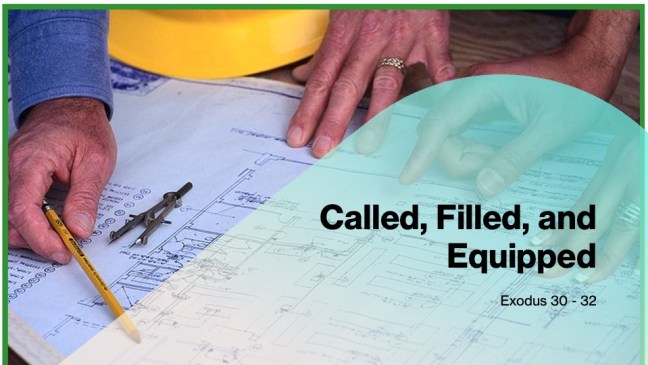
Today’s Passage – Exodus 30 – 32 (Click on the references to listen to the audio – Click here to view the passage from Blue Letter Bible)
(Second Milers also read – Luke 15 – 16; Proverbs 30; Psalms 146 – 150
Listen to this morning’s Scripture song – Psalm 55:17
Read a previous post from this passage – “Who Is On The Lord’s Side?”
“See, I have called by name Bezaleel the son of Uri, the son of Hur, of the tribe of Judah: And I have filled him with the spirit of God, in wisdom, and in understanding, and in knowledge, and in all manner of workmanship, … And I, behold, I have given with him Aholiab, the son of Ahisamach, of the tribe of Dan: and in the hearts of all that are wise hearted I have put wisdom, that they may make all that I have commanded thee;” – (Exodus 31:2-3, 6)
“But my God shall supply all your need according to his riches in glory by Christ Jesus.” – (Philippians 4:19)
“For as we have many members in one body, and all members have not the same office:” – (Romans 12:4)
“But now hath God set the members every one of them in the body, as it hath pleased him.” – (1 Corinthians 12:18)
I just want to give a quick thought from chapter 31 of the passage in Exodus that we are reading together today. I was tempted to write something from chapter 32, but I decided that this thought was more appropriate for the people of our church. I am thankful because this message is a little more encouraging than what I would have said about chapter 32.
In the preceding chapters, God has been instructing Moses regarding the Tabernacle. God gave him a complete set of blueprints, with detailed instructions about how to go about building it. The problem was that Moses was not necessarily gifted in the area of construction. He was a great leader, but he certainly did not possess all of the skills necessary to do all that needed to be done; nor would he have the time to do it all himself. God understood this, so He raised up men who were gifted in construction, at least the type of construction required for building the Tabernacle and all the furniture and coverings involved with it. These individuals were going to oversee the construction of the tabernacle so that Moses could do what he needed to do.
I remember when we were building our first little addition to the church building. It was only a 900 square foot addition to the auditorium, but honestly I knew very little about what was needed to complete it. God raised up a man in our church to oversee the construction. The project was completed on time and under budget. Everybody congratulated me on what a wonderful job I did with the building, but truthfully I had very little to do with it. And, because I didn’t have to focus on the construction, I was able to fulfill, without distraction, my primary duties of ministry. Thank God for Don Price who was gifted and used of the Lord in a great way to fulfil this particular task.
The same was true with the more recent construction of our fellowship and classroom building. God gave us several men who dedicated themselves to the task of figuring out what needed to be done to get it finished. It is a blessing to have many good people within the ministry who love God and his work and want to do what they are gifted to do so that God’s work can be accomplished.
God equips the local church with what it needs so that it can to do what God wants it to do. Part of my job as a pastor is to try to figure out what the gifts and talents are in the people, and put them to use. People who are not being used are unhappy people, and unhappy people will not stay long and their talents will be wasted. God also equips each and every one of us with what we need so that we can fulfil His will. He will never ask us to do something without providing the tools, talents, and materials that are necessary in order to get the job done.
Have you discovered what talents and abilities that God has equipped you with? What gifts has God entrusted to your life? Are you allowing Him to use all of those things for His honor and glory? Why not find a place to serve in the local church where your talents can be used to the fullest? God wants to bear fruit in your life. Allow Him to use you.
[Updated 01/30/25]
Posted in Thoughts from Exodus by Phil Erickson with 4 comments.
Pattern What You Preach

Today’s Passage – Exodus 25 – 27 (Click on the references to listen to the audio – Click here to view the passage from Blue Letter Bible)
(Second Milers also read – Luke 11 – 12; Proverbs 28; Psalms 136 – 140
Listen to this morning’s Scripture song – Psalm 48:1 & 2
Read the “0128 Evening and Morning“ devotion for today, by the late Charles Haddon Spurgeon.
In chapters 25 – 27, God is instructing Moses regarding the construction of the Tabernacle. He first tells him that he must take up an offering from the people, collecting all of the materials that would be needed in order to construct it. This was no small undertaking as the tabernacle with all of its curtains and coverings and with all of its gold, silver, and brass, not to mention the wood that would be required, was a masterpiece of magnificent beauty and elaborate detail. Yet, it is interesting to note, as we will learn later in future passages, that Moses had to eventually stop the people from giving because they had given much more than was necessary to construct the Tabernacle. We don’t see that very often today, do we. Can you imagine what could be done in our churches today if God’s people were this excited about the work of God?
God then shows Moses a pattern; a picture of what the tabernacle was to look like. He no doubt also showed him blueprints of each element of the tabernacle, including all of the pieces of furniture. Moses had a clear picture in his mind of what it all would look like when he was finished. Then, God goes on for several chapters giving Moses detailed instructions outlining precisely how the tabernacle was to be built. So, in review, we see that God showed Moses an example, and then he gave him clear instructions, or exhortation.
I got to thinking how that this is how the ministry is supposed to work. God commands those of us who minister to His people to be a good example (or pattern) of what He expects in a finished product, and then He wants us to give clear instructions of how the people are to go about it. If the picture we are presenting is not consistent with the instructions we are giving, we will not be able to clearly help the people do and be what God expects of them. I know that none of us is perfect, but it is imperitive that we keep this thought in mind as we go about our business of serving the Lord. People will sometimes learn more from what they see, than from what we tell them. Both our example and our exhortation must be right, if we are going to effectively be used of God in building the lives of people for His glory.
By the way, this does not only apply to pastors and teachers. It applies to every believer. Your life (pattern, example) must back up what you are trying to instruct people. Parents, you need to be the right examlple to your children. They will not listen to your exhortation if your example is not what it should be. And to those of you that are concerned about winning people to Christ, which should be all of us; make sure your life backs up your profession. We have an awesome obligation to show people Christ with our lives as well as to tell them with our words. Think about it? Have you given much thought to your example; your pattern? Is it sending the right message to the people around you? Do the things that you do and say point people to the Lord, or do they send a conflicting message? Just a thought.
Posted in Thoughts from Exodus by Phil Erickson with 4 comments.
Expect Opposition

Today’s Passage – Exodus 4 – 6 (Click on the references to listen to the audio – Click here to view the passage from Blue Letter Bible)
(Second Milers also read – Mark 13 – 14; Proverbs 21; Psalms 101 – 105
Listen to this morning’s Scripture song – 1 John 4:7 & 8
Read a previous post from this passage – “What’s Your Excuse“
Read the “0121 Evening and Morning“ devotion for today, by the late Charles Haddon Spurgeon.
“And they met Moses and Aaron, who stood in the way, as they came forth from Pharaoh: And they said unto them, The LORD look upon you, and judge; because ye have made our savour to be abhorred in the eyes of Pharaoh, and in the eyes of his servants, to put a sword in their hand to slay us. And Moses returned unto the LORD, and said, Lord, wherefore hast thou so evil entreated this people? why is it that thou hast sent me? For since I came to Pharaoh to speak in thy name, he hath done evil to this people; neither hast thou delivered thy people at all.” – (Exodus 5:20-23)
Moses did exactly what God had called him to do. He went to the people of Israel and convinced them that God had told him to deliver them out from under the bondage of the Egyptians. He then went to Pharaoh and demanded on behalf of God to let the people of God leave. However, things did not work out exactly the way Moses thought they would. Instead of things getting better, in the short term, things actually took a turn for the worse. Not only did Pharaoh refuse to let the people go, he also made their jobs harder by making them gather their own straw for the bricks that they had to make for their labor. Pharaoh was mad at the people, the people were mad at Moses, and Moses was mad at God.
Notice the opposition that Moses faced in the will of God:
1 He had opposition from without the congregation. I guess Pharaoh could be symbolic of the devil. The devil will vehemently oppose anyone that seeks to do the will of God.
2 He also faced opposition from within the congregation of Israel. They were all for God’s plan until their life got uncomfortable, then they wanted to go back. Many Christians today are the same way. They claim to love the Lord, and want to do His will, but when it begins to cost them something, they will often quit.
3 Notice also that Moses faced opposition from within himself. When the pressure was on him, he began to second guess the will of God.
Nobody ever said that the road was going to always be easy. You can take to the bank the fact that opposition will come to those who are doing the will of God. But you can also count on the fact that God will always bring His victory, if we will just stick with the plan and not quit.
Posted in Thoughts from Exodus by Phil Erickson with 2 comments.
Excuses

Today’s Passage – Exodus 4 – 6 (Click on the references to listen to the audio – Click here to view the passage from Blue Letter Bible)
(Second Milers also read – Mark 13 – 14; Proverbs 21; Psalms 101 – 105
Listen to this morning’s Scripture song – 1 John 4:7 & 8
Read a previous post from this passage – “Expect Opposition“
Read the “0121 Evening and Morning“ devotion for today, by the late Charles Haddon Spurgeon.
“And Moses answered and said, But, behold, they will not believe me, nor hearken unto my voice: for they will say, The LORD hath not appeared unto thee.” (Exodus 4:1)
“And Moses said unto the LORD, O my Lord, I am not eloquent, neither heretofore, nor since thou hast spoken unto thy servant: but Iam slow of speech, and of a slow tongue.” (Exodus 4:10)
“And he said, O my Lord, send, I pray thee, by the hand of him whom thou wilt send.” (Exodus 4:13)
It has always amazed me how our human nature kicks in when we are asked to do something, even when we are asked by God. There is something inside of us that immediately begins to reason that it cannot be done, or should not be done. We begin to figure out ways to get out of doing it. We don’t come right out and say that we don’t want to do it, at least not initially. We just say that it can’t be done, or shouldn’t be done, or that it will be way too difficult. Most projects get shut done by negativity before they even get off the ground.
Moses did the same thing here in Exodus 4. The first excuse that he gives is that the people will not listen. Basically he is telling God that it can’t be done. This is really nothing more than unbelief when it comes to things that God calls us to do. If it is truly of God, He will bring it to pass. All we need to do is obey Him. The results are up to Him. God does not need advisers, He needs obeyers.
The second excuse that Moses offers is really the root of the problem. I know that it is the same thing that often keeps me from fulfilling God’s will. Moses says that he is not the man for the job, that he is not able to do it. Now he is no longer doubting God’s ability or anybody else, he is merely doubting his ability to do what God asks him to do. This is not necesarily bad. We need to realize that we can’t do the work of God in our own power or ability. It can only be done through the power of God. What Moses needed to do (and what we need to do) is believe that if God asks us to do something, He will also equip us to do it. “For it is God which worketh in you both to will and to do of his good pleasure.” (Philippians 2:13) We truly can do all things through Christ which strengtheneth us.
Finally, Moses is exasperated. He just doesn’t want to do it. He tells the Lord to send somebody else. God finally convinces him to do it, but he certainly was not a willing servant initially. If we refuse to be obedient to the calling of God He may just choose somebody else, but we will miss out on the blessing of being used of God. Know this, though, that if God asks you, you are the man (or woman) for the job. Don’t refuse Him. Stretch your faith. Allow Him to show you what you can do in His strength when you are yielded to His will.
Posted in Thoughts from Exodus by Phil Erickson with 5 comments.
God’s Got the Details by Katelyn Erickson

Today’s Passage – Exodus 39 – 40 (Click on the references to listen to the audio – Click here to view the passage from Blue Letter Bible)
(Second Milers also read – Luke 21 – 22; Proverbs 2; Psalms 11 – 15)
Listen to this morning’s Scripture Song – 1 John 4:7 & 8
Read the “0202 Evening and Morning“ devotion for today, by the late Charles Haddon Spurgeon.
Read a previous post from this passage – “The Glory of the Lord“
“31 And Moses and Aaron and his sons washed their hands and their feet thereat: 32 When they went into the tent of the congregation, and when they came near unto the altar, they washed; as the LORD commanded Moses. 33 And he reared up the court round about the tabernacle and the altar, and set up the hanging of the court gate. So Moses finished the work.“ (Exodus 40:31-33)
When I read about the tabernacle I’m always amazed and thankful our God cares so much about the smallest details.
Let’s be grateful for all the beautiful, interesting parts of life that God gives us each day, but it is so important to not get overwhelmed, bogged down, or anxious over all the details.
“As the LORD commanded Moses his servant, so did Moses command Joshua, and so did Joshua; he left nothing undone of all that the LORD commanded Moses.” Joshua 11:15
As God gave out each instruction, the Bible says that Moses simply obeyed “as the Lord had commanded Moses”.
“If ye love me, keep my commandments. He that hath my commandments, and keepeth them, he it is that loveth me: and he that loveth me shall be loved of my Father, and I will love him, and will manifest myself to him.” John 14:15, 21
At the end of the book of Exodus it says “So Moses finished the work.” (40:33) We sometimes can get distracted by the complicated intricacies while really we need to keep our focus on the simplicity of just loving Him and keeping His commands…while leaving life’s nitty gritty details in His hands.
Then, we too will be able to finish the work that He has given us in this life that He has blessed up with.


Posted in Devotions, Guest Posts, Just for Ladies, Thoughts from Exodus by Katelyn Erickson with 5 comments.