The Saturday Morning Post – The Devil’s To-Do List

Today’s Passage – Isaiah 14 – 18 (Click on the references to listen to the audio – click here to view the text from the Blue Letter Bible website)
(Second Milers also read – Luke 21 – 22; Psalms 6 – 10; Proverbs 2)
Read the “0802 Evening and Morning” devotion for today, by the late Charles Haddon Spurgeon.
“How art thou fallen from heaven, O Lucifer, son of the morning! how art thou cut down to the ground, which didst weaken the nations! For thou hast said in thine heart, I will ascend into heaven, I will exalt my throne above the stars of God: I will sit also upon the mount of the congregation, in the sides of the north: I will ascend above the heights of the clouds; I will be like the most High. Yet thou shalt be brought down to hell, to the sides of the pit.” (Isaiah 14:12-15)
Good morning. Have you checked your To-Do list today? I’m sure the devil checked his. He knows his time is running out. In as few as seven years from now, he will be cast into a bottomless pit: held captive there for one-thousand years. Then the devil will be released (but not for good behavior) and deceive the nations once again, and then he is cast into the Lake of Fire that was prepared for him. So he knows his time is short. If we know what is on the devil’s To-Do list, maybe we could help him not to get anything on the list done. So here it is…
1) Devour someone.
“Be sober, be vigilant; because your adversary the devil, as a roaring lion, walketh about, seeking whom he may devour: Whom resist stedfast in the faith, knowing that the same afflictions are accomplished in your brethren that are in the world.” (1Peter 5:8-9)
It is not just you that the devil wants to devour, but your brothers and sisters in Christ from across the street and around the world. We must resist him: stand on our faith in Christ…
“Submit yourselves therefore to God. Resist the devil, and he will flee from you.” (James 4:7)
2) Steal God’s Word.
“Hear ye therefore the parable of the sower. When any one heareth the word of the kingdom, and understandeth it not, then cometh the wicked one, and catcheth away that which was sown in his heart. This is he which received seed by the way side.” (Matthew 13:18-19)
And no wonder they do not understand with all the perversions of the Bible available today. Many verses have been changed or left out; words have been changed or left out. God said he would preserve His Word…
“The words of the LORD are pure words: as silver tried in a furnace of earth, purified seven times. Thou shalt keep them, O LORD, thou shalt preserve them from this generation for ever.” (Psalm 12:6-7)
But the devil is smart, he even steals parts of verses. If you have an NIV (non-inspired version) bible (small ‘b’ on purpose) God’s Bible should only be capitalized), and you were trying to cast out a demon and found you could not do it. You would look for an example in your NIV bible. You would be led to find Matthew 17 and the account of the disciples failing to cast out a demon. You would read verse 20, and then find the passage jumps to verse 22. But where verse 21 should be, the NIV tells you to see Mark 9:29. You turn to Mark 9 and it says…
“He replied, “This kind can come out only by prayer.”
You sadly walk away, saying, “But I did pray. What went wrong?”
What went wrong? The devil stole a verse and some words…
“Howbeit this kind goeth not out but by prayer and fasting.” (Matthew 17:21)
“And he said unto them, This kind can come forth by nothing, but by prayer and fasting.” (Mark 9:29)
We can’t afford to be led astray by perverted translations of God’s True and Holy Word. Stand on the King James Bible – it’s the only Authorized Version.
3) (NOTE to self: Save this one for last!) Bow the knee, and confess that Jesus Christ is Lord.
“Let this mind be in you, which was also in Christ Jesus: Who, being in the form of God, thought it not robbery to be equal with God: But made himself of no reputation, and took upon him the form of a servant, and was made in the likeness of men: And being found in fashion as a man, he humbled himself, and became obedient unto death, even the death of the cross. Wherefore God also hath highly exalted him, and given him a name which is above every name: That at the name of Jesus every knee should bow, of things in heaven, and things in earth, and things under the earth; And that every tongue should confess that Jesus Christ is Lord, to the glory of God the Father.” (Philippians 2:5-11)
“And the devil that deceived them was cast into the lake of fire and brimstone, where the beast and the false prophet are, and shall be tormented day and night for ever and ever.” (Revelation 20:10)
So submit yourself to God, and stand on His preserved Word for the English speaking people: the King James Bible. Then you can sit back in Heaven and watch #3 happen. You should also bring others with you to see this great event: the devil hates soul winning too!
Peace!
Posted in Devotions by Pastor Ted Stahl with 1 comment.
Come Now, and Let Us Reason Together

Today’s Passage – Isaiah 1 – 4 (Click on the references to listen to the audio – click here to view the text from the Blue Letter Bible website)
(Second Milers also read – Luke 15 – 16; Psalms 141 – 145; Proverbs 30)
Listen to this morning’s Scripture song – 1 John 4:7 & 8
Read the “0730 Evening and Morning” devotion for today, by the late Charles Haddon Spurgeon.
“18 Come now, and let us reason together, saith the LORD: though your sins be as scarlet, they shall be as white as snow; though they be red like crimson, they shall be as wool. 19 If ye be willing and obedient, ye shall eat the good of the land: 20 But if ye refuse and rebel, ye shall be devoured with the sword: for the mouth of the LORD hath spoken it.” (Isaiah 1:18-20)
“I, even I, am he that blotteth out thy transgressions for mine own sake, and will not remember thy sins.” (Isaiah 43:25)
“As far as the east is from the west, so far hath he removed our transgressions from us.” (Psalm 103:12)
“And they shall teach no more every man his neighbour, and every man his brother, saying, Know the LORD: for they shall all know me, from the least of them unto the greatest of them, saith the LORD: for I will forgive their iniquity, and I will remember their sin no more.” (Jeremiah 31:34)
“I write unto you, little children, because your sins are forgiven you for his name’s sake.” (1 John 2:12)
The hymn writer James Nicholson wrote:
Whiter than snow, yes, whiter than snow,
Now wash me, and I shall be whiter than snow.
It is such a blessing to know that your sins are forgiven. The passage in Isaiah was written to the southern kingdom of Judah sometime during the life of the prophet who prophesied during the reigns of kings Uzziah, Jotham, Ahaz, and Hezekiah (Isaiah 1:1), from approximately 740 BC to 680 BC. Isaiah was warning Judah about the consequences that would surely come to them, as it did to the northern kingdom, if they did not repent and turn back to God. He promises them if they “be willing and obedient” God will forgive them and prosper them once again as a nation.
Though these verses were written to the people of Judah corporately, we often apply them individually to believers today. God forgives us if we repent of our sin and turn to the Lord Jesus Christ for salvation. Forgiveness is only possible through the blood of the Lord Jesus Christ. The wrath that we deserved was poured out upon Him. However, God goes beyond just forgiving us: He forgets our sins as well. To forgive is one thing, but to forget is another level entirely. The phrase “blotteth out” (Isaiah 43:25) has the idea that the record of our sin has been completely expunged (removed).
Now let’s try to apply this wonderful attribute of God to our own relationships. We are supposed to be like God, aren’t we? If we are saved, we are being conformed to the image of Christ and we have God on the inside of us transforming us to be like Him. If all that be true, then we should be able to forget like God forgets. We say that we forgive someone who has wronged us, but we often replay mentally (or re-tell verbally) the act that was committed against us. In other words, the act has not been blotted out completely in our minds. We store the thing that was forgiven in a special compartment where we can retrieve it again in case we need it. We often pull it back out when a new violation is committed. We are keeping score in our minds. God does not do this. He removes the record altogether. Real forgiveness will lead us to blot out the act altogether; not that their will be no consciousness of the act; but it will not be allowed to be dredged back up again for some future judgment against the offender.
I have one more thought. God not only forgives sin and erases the record, but He also refuses to record any future violations. It is like getting a completely free pass from the penalty of your sins. Don’t believe me?
“But to him that worketh not, but believeth on him that justifieth the ungodly, his faith is counted for righteousness. Even as David also describeth the blessedness of the man, unto whom God imputeth righteousness without works, Saying, Blessed are they whose iniquities are forgiven, and whose sins are covered. Blessed is the man to whom the Lord will not impute sin.” – (Romans 4:5-8)
Oh that we could be more like Him: forgiving, forgetting, and even determining that we will not hold against someone any future acts committed against us. We like to be the receiver of such treatment, but we struggle to treat others in this manner.
God, help us to be more like you. Help us to love people like you do. Help us to truly accept the forgiveness that you offer us, and then help us to return the favor to someone else.
Perhaps as you are reading this, God has put someone in your mind that you are harboring unforgiveness toward. Why not determine to take that person out of your heart’s prison by giving them the forgiveness that God has given you. It is reasonable for us who are forgiven to treat others as God has treated us.
“And be ye kind one to another, tenderhearted, forgiving one another, even as God for Christ’s sake hath forgiven you.” – (Ephesians 4:32)
Posted in Devotions by Phil Erickson with 1 comment.
The Saturday Morning Post – Don’t Lose Your Head
Today’s Passage – Ecclesiastes 5 – 8 (Click on the references to listen to the audio – click here to view the text from the Blue Letter Bible website)
(Second Milers also read – Luke 7 – 8; Psalms 120 – 125; Proverbs 26)
Read the “0726 Evening and Morning” devotion for today, by the late Charles Haddon Spurgeon.
“Consider the work of God: for who can make that straight, which he hath made crooked?” (Ecclesiastes 7:13)
“And at the end of the days I Nebuchadnezzar lifted up mine eyes unto heaven, and mine understanding returned unto me, and I blessed the most High, and I praised and honoured him that liveth for ever, whose dominion is an everlasting dominion, and his kingdom is from generation to generation: And all the inhabitants of the earth are reputed as nothing: and he doeth according to his will in the army of heaven, and among the inhabitants of the earth: and none can stay his hand, or say unto him, What doest thou?” (Daniel 4:34-35)
“For I am the LORD: I will speak, and the word that I shall speak shall come to pass; it shall be no more prolonged: for in your days, O rebellious house, will I say the word, and will perform it, saith the Lord GOD.” (Ecclesiastes 12:25)
Good morning. Did you wake up this morning? Good. It’s all part of God’s perfect plan. Everything goes according to God’s plan. If He wants something to be crooked, it is crooked; and remains crooked until He makes it straight again: but we ourselves cannot make the crooked straight (see Ecclesiastes 7:13). God is sovereign: He does everything according to His will (see Daniel 4:34-35). And whatever He says He will do, He will do (see Ecclesiastes 12:25). This is why we can trust in God’s Word: He will perform it.
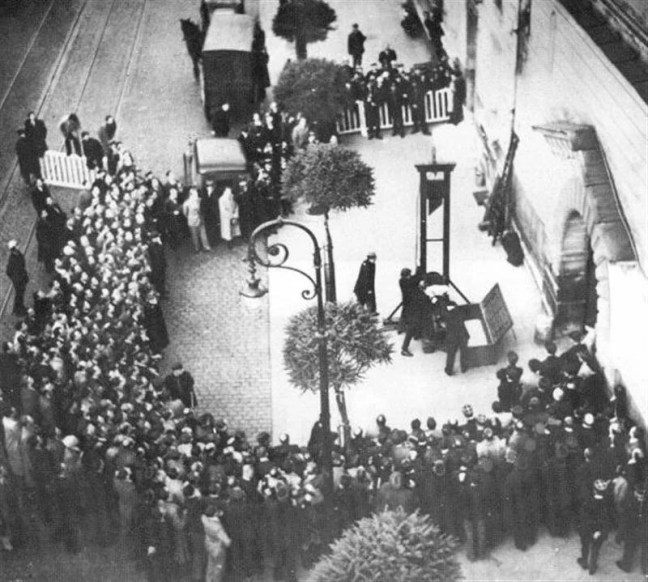
There are may prophecies given in the Word of God. One in particular, I got from NBC news. Back in 2014 there were two executions that took place within two weeks of each other. The first was a convict in Ohio. The doctors shot the two deadly chemicals into the man’s arm. Halfway through the procedure, he woke up screaming in agony. It took that convicted murderer a half-hour to die. A few days later, another execution was about to take place in Arizona. The convict was injected with the same two drugs used in the Ohio execution. after a few minutes, his body started to convulse. This time it took over two hours for that man to die. People protested the use of lethal drugs for executions, other’s were glad he suffered and suggested that Drano be used. As I read through the article, I clicked on a link. There in big bold letters was the headline I knew we would see one day…
Appeals Judge Says Guillotine ‘Probably Best’ for Executions By Tracy Connor
When you think of all the ways we have to execute people, the Guillotine seems to be the most humane. It would also fit in with God’s plan for those saved during the tribulation period…
“And I saw thrones, and they sat upon them, and judgment was given unto them: and I saw the souls of them that were beheaded for the witness of Jesus, and for the word of God, and which had not worshipped the beast, neither his image, neither had received his mark upon their foreheads, or in their hands; and they lived and reigned with Christ a thousand years.” (Revelation 20:4)
God’s plan, and purpose: He will preform it.
Peace.
Posted in Devotions by Pastor Ted Stahl with no comments yet.
The Saturday Morning Post – Perilous Times

Today’s Passage – Proverbs 13 – 15 (Click on the references to listen to the audio – click here to view the text from the Blue Letter Bible website)
(Second Milers also read – Mark 9 – 10; Psalms 91 – 95; Proverbs 19)
Read the “0719 Evening and Morning” devotion for today, by the late Charles Haddon Spurgeon.
“Righteousness exalteth a nation: but sin is a reproach to any people.” (Proverbs 14:34)
“This know also, that in the last days perilous times shall come. For men shall be lovers of their own selves, covetous, boasters, proud, blasphemers, disobedient to parents, unthankful, unholy, Without natural affection, trucebreakers, false accusers, incontinent, fierce, despisers of those that are good, Traitors, heady, highminded, lovers of pleasures more than lovers of God; Having a form of godliness, but denying the power thereof: from such turn away.” (2Timothy 3:1-5)
Good morning. Here is what God says about some of the issues going on in these perilous times.
Child Abuse…
“…Verily I say unto you, Except ye be converted, and become as little children, ye shall not enter into the kingdom of heaven. Whosoever therefore shall humble himself as this little child, the same is greatest in the kingdom of heaven. And whoso shall receive one such little child in my name receiveth me. But whoso shall offend one of these little ones which believe in me, it were better for him that a millstone were hanged about his neck, and that he were drowned in the depth of the sea. Woe unto the world because of offences! for it must needs be that offences come; but woe to that man by whom the offence cometh!” (Matthew 18:3-7)
Sodomites and Lesbians…
“Wherefore God also gave them up to uncleanness through the lusts of their own hearts, to dishonour their own bodies between themselves: Who changed the truth of God into a lie, and worshipped and served the creature more than the Creator, who is blessed for ever. Amen. For this cause God gave them up unto vile affections: for even their women did change the natural use into that which is against nature: And likewise also the men, leaving the natural use of the woman, burned in their lust one toward another; men with men working that which is unseemly, and receiving in themselves that recompence of their error which was meet.” (Romans 1:24-27)
Murder…
“And surely your blood of your lives will I require; at the hand of every beast will I require it, and at the hand of man; at the hand of every man’s brother will I require the life of man. Whoso sheddeth man’s blood, by man shall his blood be shed: for in the image of God made he man.” (Genesis 9:5-6)
And the list goes on, but…
“Righteousness exalteth a nation: but sin is a reproach to any people.” (Proverbs 14:34)
The wages of sin is still death, whether saved or unsaved: Christian or non-Christian. If you sin, God may choose to take you home to Heaven if you are a Christian: a born-again believer in the Lord Jesus Christ; or if you never received Jesus as your personal Saviour this is what is waiting for you…
“But the fearful, and unbelieving, and the abominable, and murderers, and whoremongers, and sorcerers, and idolaters, and all liars, shall have their part in the lake which burneth with fire and brimstone: which is the second death.” (Revelation 21:8)
“Righteousness exalteth a nation: but sin is a reproach to any people.” (Proverbs 14:34)
America is in deep, deep trouble. But righteousness will exalt a nation. There is no righteousness in a government that lies. There is no righteousness in those who abuse children, use them in pornography, or leave them in hot cars to bake. There is no righteousness where you could be sitting on your porch and someone drives by with a gun and puts a bullet in your head. Where there is no righteousness, there is sin. And sin is a reproach to any people. We are all affected by sin. America is in trouble, and Jesus is the only solution. I’m going to end with this last verse…
“Let us hear the conclusion of the whole matter: Fear God, and keep his commandments: for this is the whole duty of man.” (Ecclesiastes 12:13)
Peace.
Posted in Devotions by Pastor Ted Stahl with no comments yet.
Are You Happy?

Today’s Reading – Psalms 140 – 145 (Click on the references to listen to the audio – Click here to view the passage from Blue Letter Bible)
(Second Milers also read – Matthew 25 – 26; Psalms 61 – 65; Proverbs 13)
Listen to this morning’s Scripture song – Psalm 61:1 – 3
Read the “0713 Evening and Morning” devotion for today, by the late Charles Haddon Spurgeon.
“Happy is that people, that is in such a case: yea, happy is that people, whose God is the LORD.” (Psalm 144:15)
Years ago, I was researching some ideas for a new gospel tract for the church. I came across one that really caught my attention. On the front cover it had a picture of a smily face with the question, “Are You Happy?” I thought that this tract would be a great attention getter for others as well; but I wondered, is it biblical? I’m not talking about the contents of the tract, which is doctrinally sound. I am talking about the concept of happiness. What does the Bible really say about happiness? I had always been taught that God’s people can be joyful, but joy is deeper that happiness. In other words, you can be joyful even when you’re not happy. I suppose that may be true at times, but I did a little more research and discovered that the Bible very clearly teaches that God’s children should be a happy people. Don’t misunderstand, I am not saying that there will be times in our lives when we are sad; and to some degree I think feeling sad is good for us and part of our complete emotional makeup. But, for the most part, we who are saved ought to be the happiest people on the planet. Why? Because we have an awful lot to be happy about.
Consider what the Word of God says about happiness:
“Behold, happy is the man whom God correcteth: therefore despise not thou the chastening of the Almighty:”(Job 5:17)
“Blessed is every one that feareth the LORD; that walketh in his ways. For thou shalt eat the labour of thine hands: happy shalt thou be, and it shall be well with thee.” (Psalm 128:1&2)
“Happy is he that hath the God of Jacob for his help, whose hope is in the LORD his God:” (Psalm 146:5)
“Happy is the man that findeth wisdom, and the man that getteth understanding.” (Psalm 3:13)
“He that despiseth his neighbour sinneth: but he that hath mercy on the poor, happy is he.” (Proverbs 14:21)
“Happy is the man that feareth alway: but he that hardeneth his heart shall fall into mischief.” (Proverbs 28:14)
I could list some more verses, but I think you get the idea. Why then are so many Christians miserable, discontented people? Why are we always so negative? It’s no wonder, we are failing terribly at reaching the world with the gospel. Why should the lost world want what we claim to have with our doctrine, but fail to demonstrate in a happy, contented life. I don’t think happiness is all that elusive. I think it can be found in a right relationship with God. By that I mean that you are saved and yielded to the Spirit of God, surrendered to His will. If you are saved and still doing things your way, you are not going to be happy, because you will have an inner turmoil going on inside of you as God the Holy Spirit works to bring you into submission.
By the way, we ordered the tract, and it was a great eye catcher. We even had a special series of messages surrounding the theme “Are You Happy?”.
Posted in Devotions by Phil Erickson with 1 comment.
The Saturday Morning Post – The Gap Theory

Today’s Reading – July 12 – Psalms 133 – 139 (Second Milers also read – Matthew 23 – 24; Psalms 56 – 60; Proverbs 12)
“To him which divided the Red sea into parts: for his mercy endureth for ever: And made Israel to pass through the midst of it: for his mercy endureth for ever: But overthrew Pharaoh and his host in the Red sea: for his mercy endureth for ever.” (Psalm 136:13-15)
Good morning. Just a quick question about something here: when you read your Bible, does God ever give you a thought about something? It could be something to make you more like Jesus. It could be something that corrects the direction you are going. Or it could be just a thought. But do you get anything out of God’s Word when you read your Bible? What I want to show you was just a thought, but it was a thought that God gave me. Maybe I really shouldn’t say it was JUST a thought, to me it’s more than that. But anyway, one thought lead to another, which is in the Book of Exodus…
“And the LORD said unto Moses, Wherefore criest thou unto me? speak unto the children of Israel, that they go forward: But lift thou up thy rod, and stretch out thine hand over the sea, and divide it: and the children of Israel shall go on dry ground through the midst of the sea. And I, behold, I will harden the hearts of the Egyptians, and they shall follow them: and I will get me honour upon Pharaoh, and upon all his host, upon his chariots, and upon his horsemen. And the Egyptians shall know that I am the LORD, when I have gotten me honour upon Pharaoh, upon his chariots, and upon his horsemen. And the angel of God, which went before the camp of Israel, removed and went behind them; and the pillar of the cloud went from before their face, and stood behind them: And it came between the camp of the Egyptians and the camp of Israel; and it was a cloud and darkness to them, but it gave light by night to these: so that the one came not near the other all the night.” (Exodus 14:15-20)
That’s the gap: the space of time: all night the Egyptians and the Israelites were not able to come near each other because of the cloud. Genesis 3:6-7 show us a gap between the first sin, and judgment…
“And when the woman saw that the tree was good for food, and that it was pleasant to the eyes, and a tree to be desired to make one wise, she took of the fruit thereof, and did eat, and gave also unto her husband with her; and he did eat. And the eyes of them both were opened, and they knew that they were naked; and they sewed fig leaves together, and made themselves aprons.” (Genesis 3:6-7)
The gap is the time they used to sew together the fig leaves. And then there was the so-called prophetess at Thyatira: Jezebel…
“Notwithstanding I have a few things against thee, because thou sufferest that woman Jezebel, which calleth herself a prophetess, to teach and to seduce my servants to commit fornication, and to eat things sacrificed unto idols. And I gave her space to repent of her fornication; and she repented not. Behold, I will cast her into a bed, and them that commit adultery with her into great tribulation, except they repent of their deeds.” (Revelation 2:20-22)
God made a gap for Jezebel; He gave her space of time to repent but she would not.
“The Lord is not slack concerning his promise, as some men count slackness; but is longsuffering to us-ward, not willing that any should perish, but that all should come to repentance.” (2Peter 3:9).
God made a gap for Adam and Eve. The ran from God, hid themselves, and tried to cover up their nakedness with fig leaves when they should have run to God…
“If we confess our sins, he is faithful and just to forgive us our sins, and to cleanse us from all unrighteousness.” (1John 1:9)
And then there is the gap that God made for the Egyptians that lasted all night. God may have made this gap for those Egyptians who would forsake their duty to Egypt and Pharaoh’s army. We still have these today, and they’re called deserters. Think about it. They had just seen their nation destroyed by plagues and the death of all the firstborns. They saw the cloud that blocked them from getting to the Israelites. And then when the cloud finally lifted, they saw the Red Sea parted, and Israel walking across on dry land. After all of that, there may have been a few who did not care to fight against the Only True Living God. God made a gap for them. Did any of them take this gift of life from God?
“And the Egyptians pursued, and went in after them to the midst of the sea, even all Pharaoh’s horses, his chariots, and his horsemen. And it came to pass, that in the morning watch the LORD looked unto the host of the Egyptians through the pillar of fire and of the cloud, and troubled the host of the Egyptians, And took off their chariot wheels, that they drave them heavily: so that the Egyptians said, Let us flee from the face of Israel; for the LORD fighteth for them against the Egyptians. And the LORD said unto Moses, Stretch out thine hand over the sea, that the waters may come again upon the Egyptians, upon their chariots, and upon their horsemen. And Moses stretched forth his hand over the sea, and the sea returned to his strength when the morning appeared; and the Egyptians fled against it; and the LORD overthrew the Egyptians in the midst of the sea. And the waters returned, and covered the chariots, and the horsemen, and all the host of Pharaoh that came into the sea after them; there remained not so much as one of them.” (Exodus 14:23-28)
Not so much as one of them.
Why would God give an army who hated God’s people, the couple who enabled God’s people to sin, and a prophetess that caused God’s people to sin, a gap of time to repent: to change their minds about what they had done or were doing? The answer is found at the end of all 26 verses of Psalm 136: for His mercy endureth for ever.
Do you find yourself in a gap today: a space of time given to you by God? Use your time wisely.
Peace.
Posted in Devotions by Pastor Ted Stahl with 1 comment.
An Heritage of the Lord

Today’s Reading – Psalms 120 – 132 (Click on the references to listen to the audio – Click hereto view the passage from Blue Letter Bible)
(Second Milers also read – Matthew 21 – 22; Psalms 51 – 55; Proverbs 11)
Listen to this morning’s Scripture song – Psalm 51
Read the “0711 Evening and Morning” devotion for today, by the late Charles Haddon Spurgeon.
“3 Lo, children are an heritage of the LORD: and the fruit of the womb is his reward. 4 As arrows are in the hand of a mighty man; so are children of the youth. 5 Happy is the man that hath his quiver full of them: they shall not be ashamed, but they shall speak with the enemies in the gate.” (Psalm 127:3-5)
Psalms 120 – 134 are all “songs of degrees”, which means songs of steps or ascents. It is believed that these 15 psalms were sung by the returning remnant as they travelled back to Jerusalem from Babylon.
“And he came to Jerusalem in the fifth month, which was in the seventh year of the king. For upon the first day of the first month began he to go up (same as the word translated ‘degrees’)from Babylon, and on the first day of the fifth month came he to Jerusalem, according to the good hand of his God upon him. For Ezra had prepared his heart to seek the law of the LORD, and to do it, and to teach in Israel statutes and judgments.” (Ezra 7:8-10)
It is also said that the Israelites would sing these songs as they travelled up to Jerusalem three times in the year for the feasts of Tabernacle, Passover, and Pentecost. Because of this some have called these psalms, Pilgrim Songs, or “songs of the pilgrim caravans”.
Four of these songs are attributed to David. (Psalms 122, 124, 131, and 133)
Martin Luther called these “the gradual psalms, songs of the higher choir”.
J. Vernon McGee also points out that there is a spiritual significance to these steps:
There is a spiritual meaning in these fifteen psalms. It is interesting that many writers of the Talmud pointed out the fact that life is like this—it is an ascent. We come to God as sinners who are away from Him, separated, and alienated. We come to Him for salvation, and having come for salvation, we go on to sanctification as we grow in grace and in the knowledge of Christ; it is a constant going up. We are to be climbing in a spiritual way. My friend, you and I ought to be farther along today than we were last year.[1]
So, these songs were not only geared for a physical ascent into a geographical city, they were also for a people who were “going up” spiritually – growing in their maturity and faith.
Introduction to Psalm 127
Notice that this particular psalm was a “song of degrees for Solomon.” Psalm 72 also was “a psalm for Solomon.
John Phillips believes that the psalm was written by Solomon, but he also states that he believed that it was added to the Hebrew Hymnbook by Hezekiah.
Wiersbe believes the psalm fits in within the historical context of Nehemiah and his re-building of the walls of Jerusalem after the Babylonian / Persian captivity.
The wording seems to indicate that this psalm was written for Solomon, not by Solomon, though many theologians attribute this psalm to him. When we consider Solomon with the first verse, we think of the building of the House of God – the Temple.
This psalm could be referred to as a family psalm. (See also Psalm 112 and 128)
This is almost the opposite of the way our culture sees children. John Phillips said this about the trend today that many couples are choosing not to have children:
Today there is a trend, even among Christians, to refrain from having children. They are not looked on as a blessing but as a burden. Nowadays so many people have heart-rending problems with rebellious children that some are suggesting it might be just as well to refrain from having children at all. After all, why spend one’s life—one’s strength, money, and emotions—bringing up children only to have them repay it all with defiance? To have them disobey, trample on one’s ideals, spurn the living God, involve themselves in drugs and sex and open sin? The chances against seeing one’s children avoid all the terrible pitfalls set for them by society today are so slim that increasing numbers of people are concluding they would be better off without them.
Then, too, the world is becoming increasingly dangerous. The superpowers are glaring at each other across the width of the world, armed with ICBMs tipped with multiple nuclear warheads. Terrorism is on the rise. Vice and violence are barely checked by society. Foul sins are accepted as permissible, even smiled upon. The church has lost its authority and most of its power. Why have children? Wouldn’t it be best to avoid bringing little ones into such a dangerous world? It is an appealing philosophy and it is occurring to many.[2]
Mrs. Wesley did not think that way. John and Charles Wesley were number 13 and 17 of Susannah Wesley’s children. What would the world be like without these two giants of the faith?
You will recall that God promised Abraham in the Abrahamic covenant that he would have innumerable offspring:
“And he brought him forth abroad, and said, Look now toward heaven, and tell the stars, if thou be able to number them: and he said unto him, So shall thy seed be.” (Genesis 15:5)
Notice the reference in v. 4 to arrows. It takes a great deal of skill to learn how to direct the path of an arrow accurately, and it takes a great deal of diligence to raise godly children in this sin-cursed world. The world is trying to mold them into its box, the devil is constantly on his mission of deceiving, and the child’s own flesh is working against what the spirit of God is trying to do:
“For the flesh lusteth against the Spirit, and the Spirit against the flesh: and these are contrary the one to the other: so that ye cannot do the things that ye would.” (Galatians 5:17)
It takes a great deal of love mixed with prayer, instruction, correction, and protection to produce godly kids:
“Train up a child in the way he should go: and when he is old, he will not depart from it.”(Proverbs 22:6)
The culture that we live in would say that we are being irresponsible in this age of birth control to have a large family, but the Bible would take exception to that philosophy. My sympathies go out to those who were, or are now, unable to have children of their own.
Cindy and I have four children, and ten grandchildren. Frankly, I wish we had more. (Hint – Hannah!)
Notice in v. 5 that children will be a defense for the home and family. This was particularly true in Bible days. Notice the reference to “the gate”. The city gate was a place where business matters were discussed. (Ruth 4:1) However, in this context, the reference may very well be to the gate of the man’s property.
They will also support the family, especially the elderly parents in their old age. The Amish often build a “dawdy house” on their property for the grandparents. Sometimes, it is even attached to the house like an in-law suite.
Cindy and I are both in our sixties. We have no life insurance. We have very little in retirement savings, but we have God and we have the children that God has given us who would each not hesitate at making sure that we are taken care of.
[1] McGee, J. V. (1997). Thru the Bible commentary (electronic ed., Vol. 2, p. 851). Nashville: Thomas Nelson.
[2] Phillips, J. (2012). Exploring Psalms 89–150: An Expository Commentary (Vol. 2, Ps 127:3). Kregel Publications; WORDsearch Corp.
Posted in Devotions by Phil Erickson with 3 comments.
The Saturday Morning Post – Five Ways To Praise The Lord

Today’s Reading – Psalms 96 – 102 (Click on the references to listen to the audio – Click here to view the passage from Blue Letter Bible)
(Second Milers also read – Matthew 9 – 10; Psalms 21 – 25; Proverbs 5)
Read the “0705 Evening and Morning” devotion for today, by the late Charles Haddon Spurgeon
“A Psalm of praise. Make a joyful noise unto the LORD, all ye lands. Serve the LORD with gladness: come before his presence with singing. Know ye that the LORD he is God: it is he that hath made us, and not we ourselves; we are his people, and the sheep of his pasture. Enter into his gates with thanksgiving, and into his courts with praise: be thankful unto him, and bless his name. For the LORD is good; his mercy is everlasting; and his truth endureth to all generations.” (Psalm 100)
Good morning! Today, I want to give you five ways to praise the LORD.
1) Make a joyful noise (vs 1). This means to give a shout of joy! At a Seahawks Football game last December, fans broke the Guinness World Record for loudest crowd noise in history. At 137.6 decibels, the sound is almost equivalent to the sound jet engines make during takeoff. This is the kind of praise, the joyful noise that Christians should be giving to God.
2) Serve the LORD with gladness (vs 2).
“Servants, obey in all things your masters according to the flesh; not with eyeservice, as menpleasers; but in singleness of heart, fearing God: And whatsoever ye do, do it heartily, as to the Lord, and not unto men; Knowing that of the Lord ye shall receive the reward of the inheritance: for ye serve the Lord Christ.” (Colossians 3:22-24)
3) Know the LORD (vs 3) that…
…He is God.
“In the beginning was the Word, and the Word was with God, and the Word was God.” (John 1:1)
…He created us.
“All things were made by him; and without him was not any thing made that was made.” (John 1:3)
…He purchased us, and we belong to Him.
“What? know ye not that your body is the temple of the Holy Ghost which is in you, which ye have of God, and ye are not your own? For ye are bought with a price: therefore glorify God in your body, and in your spirit, which are God’s.” (1Corinthians 6:19-20)
4) Be thankful (vs 4a & 4c). Think about all the blessings the LORD has blessed you with, and thank Him.
“And let the peace of God rule in your hearts, to the which also ye are called in one body; and be ye thankful.” (Colossians 3:15)
5) Testify on what the LORD has done for you (vs 4b). He loved you so much, that He shed His precious blood so you could be with Him in heaven…
“For God so loved the world, that he gave his only begotten Son, that whosoever believeth in him should not perish, but have everlasting life.” (John 3:16)
“And we know that the Son of God is come, and hath given us an understanding, that we may know him that is true, and we are in him that is true, even in his Son Jesus Christ. This is the true God, and eternal life.” (1John 5:20)
The LORD is good; his mercy is everlasting; and his truth endureth to all generations. So…
“Let every thing that hath breath praise the LORD. Praise ye the LORD.” (Psalm 150:6)
Peace.
Posted in Devotions by Pastor Ted Stahl with no comments yet.
David’s Prayer in a Seemingly Hopeless Situation

Today’s Reading – Psalms 69 – 72 (Click on the references to listen to the audio – Click here to view the passage from Blue Letter Bible)
(Second Milers also read – Revelation 13 – 16; Psalms 141 – 145; Proverbs 29)
Listen to this morning’s Scripture song – 1 John 3:1
Read the “0629 Evening and Morning” devotion for today, by the late Charles Haddon Spurgeon
Read a another post from this morning’s reading passage – “Who Are You Magnifying?”
Psalm 69
“Save me, O God; for the waters are come in unto [my] soul. 2 I sink in deep mire, where [there is] no standing: I am come into deep waters, where the floods overflow me. 3 I am weary of my crying: my throat is dried: mine eyes fail while I wait for my God.” (Psalm 69:1 – 3)
This psalm is quoted more in the New Testament than any other save Psalm 22 and Psalm 119.
Notice in the introductory material that this psalm is a psalm of David, and it is upon Shoshannim. We have seen this word once before in the introduction to Psalm 45. The word means “Lily”. It is translated “Lily” in 13 other places in the Old Testament, 8 of which are in the Song of Solomon:
“I am the rose of Sharon, and the lily of the valleys.” (Song of Songs 2:1)
This psalm is messianic in that it speaks of Christ (vs. 4, 21), and it is imprecatory, in that it calls for judgment upon David’s enemies.
I David’s Problem (vs. 1 – 12)
The historical context of this psalm is not revealed.
In v. 1, David cries out to God to save him.
David uses the metaphor of a drowning man, which he has done before in Psalm 18:4 – 6, and in other places:
“The sorrows of death compassed me, and the floods of ungodly men made me afraid. The sorrows of hell compassed me about: the snares of death prevented me. In my distress I called upon the LORD, and cried unto my God: he heard my voice out of his temple, and my cry came before him, even into his ears.” (Psalms 18:4-6)
Sometimes the problems of life overwhelm us and suffocate us. The language used here vividly describes David’s hopelessness as well as his despair (v. 3).
Notice in v. 4 that David was hated “without a cause”, but in vs. 7 & 9 David reveals that their hatred of him was due to his love for God.
People that hate God will hate God’s children:
“Yea, and all that will live godly in Christ Jesus shall suffer persecution.” (2 Timothy 3:12 KJV)
David’s problems lead him to pray.
II David’s Petition (v. 6; vs. 13 – 28)
David prays for his own deliverance. (vs. 13 – 21)
David prays for his enemies’ demise. (vs. 22 – 28)
Our Lord told us to love our enemies; to pray for our enemies; and to even do good to them:
“Ye have heard that it hath been said, Thou shalt love thy neighbour, and hate thine enemy. But I say unto you, Love your enemies, bless them that curse you, do good to them that hate you, and pray for them which despitefully use you, and persecute you; That ye may be the children of your Father which is in heaven: for he maketh his sun to rise on the evil and on the good, and sendeth rain on the just and on the unjust. For if ye love them which love you, what reward have ye? do not even the publicans the same? And if ye salute your brethren only, what do ye more than others? do not even the publicans so? Be ye therefore perfect, even as your Father which is in heaven is perfect.” (Matthew 5:43-48)
Our petition should lead us to praise.
III David’s Praise (vs. 29 – 36)
This is a familiar pattern in the Psalms. David praises God before the deliverance came, because he knew that deliverance would come. He trusted that God would ultimately deliver him, no matter how bad the situation looked.
Posted in Devotions by Phil Erickson with 1 comment.
The Saturday Morning Post – One Nation Under God
Today’s Reading – Psalms 65 – 68 (Click on the references to listen to the audio – Click here to view the passage from Blue Letter Bible)

(Second Milers also read – Revelation 10 – 12; Psalms 136 – 140; Proverbs 28)
Read the “0628 Evening and Morning” devotion for today, by the late Charles Haddon Spurgeon
“To the chief Musician on Neginoth, A Psalm or Song. God be merciful unto us, and bless us; and cause his face to shine upon us; Selah. That thy way may be known upon earth, thy saving health among all nations. Let the people praise thee, O God; let all the people praise thee. O let the nations be glad and sing for joy: for thou shalt judge the people righteously, and govern the nations upon earth. Selah. Let the people praise thee, O God; let all the people praise thee. Then shall the earth yield her increase; and God, even our own God, shall bless us. God shall bless us; and all the ends of the earth shall fear him.” (Psalm 67)
Good morning. July 4th is almost upon us. We will be 249 years old. Will we make it to 250 years? The only way is by relying on the Lord Jesus Christ. When we become self-sufficient, we have no need for God. That’s the attitude of some in America today. God even warned Israel about this…
“And it shall be, when the LORD thy God shall have brought thee into the land which he sware unto thy fathers, to Abraham, to Isaac, and to Jacob, to give thee great and goodly cities, which thou buildedst not, And houses full of all good things, which thou filledst not, and wells digged, which thou diggedst not, vineyards and olive trees, which thou plantedst not; when thou shalt have eaten and be full; Then beware lest thou forget the LORD, which brought thee forth out of the land of Egypt, from the house of bondage.” (Deuteronomy 6:10-12)
They’ve taken the Bible out of the schools. They’ve taken God’s commandments out of our courtrooms. They’ve tried to remove God from everything that is America. They’ve even tried to remove “In God we trust.” from our money. God continues the warning…
“Ye shall not go after other gods, of the gods of the people which are round about you; (For the LORD thy God is a jealous God among you) lest the anger of the LORD thy God be kindled against thee, and destroy thee from off the face of the earth.” (Deuteronomy 6:14-15)
George Washington, our first president of the United States, had a dream. This is the last part of the dream…
“Then once more I beheld the villages, towns, and cities springing up where I had seen them before, while the bright angel, planting the azure standard he had brought in the midst of them, cried with a loud voice, ‘While the stars remain, and the heavens send down dew upon the earth, so long shall the Union last.’ And taking from his brow the crown on which was blazoned the word “Union,” he placed it upon the Standard, while the people, kneeling down, said, ‘Amen.'”The scene instantly began to fade and dissolve, and I at last saw nothing but the rising, curling vapor I at first beheld. This also disappearing, I found myself once more gazing upon the mysterious visitor, who, in the same voice I had heard before, said, ‘Son of the Republic, what you have seen is thus interpreted: Three great perils will come upon the Republic. The most fearful is the third, passing which the whole world united shall not prevail against her. Let every child of the Republic learn to live for his God, his land, and the Union.’ With these words the vision vanished, and I started from my seat, and felt that I had seen a vision wherein had been shown me the birth, progress, and destiny of the United States.”
“Such, my friends,” Anthony Sherman concluded, “were the words I heard from General Washington’s own lips, and America will do well to profit by them.”
I found this interesting: from 1861 through 1865; 625,000 were killed on American soil in the Civil War.
From 1918 through 1919; 675,000 were killed on American soil by the Flu Pandemic; an estimated 30 to 50 million were killed world wide.
Were these the first two perils our nation would face? I don’t know: I’m not a prophet nor an interpreter of dreams. If it is a true vision by George Washington, then there is a third peril on the horizon that is coming. Will another 600,000 + Americans die on American soil? I’m not one for visions of angels or dreams, but this I know…
“If my people, which are called by my name, shall humble themselves, and pray, and seek my face, and turn from their wicked ways; then will I hear from heaven, and will forgive their sin, and will heal their land.” (2Chronicles 7:14)
America is in trouble, and only turning back to God can heal our once great nation.
Peace.
Posted in Devotions by Pastor Ted Stahl with 1 comment.