The Saturday Morning Post – God Is Still On The Throne

Today’s Passage – Hosea 8 – 14 (Click on the references to listen to the audio – click here to view the text from the Blue Letter Bible website)
(Second Milers also read –1 Peter 1 – 5; Psalms 96 – 100; Proverbs 20)
Read the “0920 Evening and Morning“ devotion for today, by the late Charles Haddon Spurgeon.
“For Israel hath forgotten his Maker, and buildeth temples; and Judah hath multiplied fenced cities: but I will send a fire upon his cities, and it shall devour the palaces thereof.” (Hosea 8:14)
Good morning. God is still on the throne, and prayer changes things. I always wanted to use that opening line from South West Radio Church. In our verse, we find that Israel has forgotten God, but God is still on the throne. Judah thinks having a large amount of fenced cities will protect him from the God he to has forgotten about. But God is still on the throne. God is till on the throne, and in complete control. And God is getting ready to send fire upon the temples of Israel, and the fenced cities of Judah. God IS still on the throne, but also: prayer changes things.
“If my people, which are called by my name, shall humble themselves, and pray, and seek my face, and turn from their wicked ways; then will I hear from heaven, and will forgive their sin, and will heal their land.” (2Chronicles 7:14)
Because God is still on the throne, and prayer still changes things.
America has forgotten it’s Maker. America has forgotten God. They teach that there is no God. And they build fenced cities, but Homeland Security will not protect them because God is still on the throne, but prayer changes things. America has all of it’s idols on TV. But God is still on the throne, and prayer changes things.
“If that nation, against whom I have pronounced, turn from their evil, I will repent of the evil that I thought to do unto them.” (Jeremiah 18:8)
Peace.
Posted in Devotions by Pastor Ted Stahl with 2 comments.
Hosea

Today’s Passage – Hosea 1 – 7 (Click on the references to listen to the audio – click here to view the text from the Blue Letter Bible website)
(Second Milers also read – James 1 – 5; Psalms 91 – 95; Proverbs 19)
Listen to this morning’s Scripture song – Isaiah 51:11
Read the “0919 Evening and Morning“ devotion for today, by the late Charles Haddon Spurgeon.
A preacher cannot separate his personal life from his ministry. The life of a spiritual leader can be as much of a message as the words that he delivers on behalf of God. However, Hosea was a preacher that was asked by God to do far more than just live a life consistent with his message. He was asked to do incredible things in his personal life that were going to serve as illustrations to the people of Israel. God commanded him to marry a woman who would not be faithful to him, and to continue to pursue her even after she had strayed. This was to serve as a picture of God’s unconditional love for Israel. Israel had played the harlot throughout her history, yet God still loved her and was willing to forgive her and redeem her if she would sincerely turn back to Him.
Background Information
Hosea was a prophet to the northern kingdom of Israel from approximately 750 BC until 710 BC. He was contemporary with (though younger than) Amos, who also prophesied to the northern kingdom during the reign of King Jereboam II. While Hosea and Amos were prophesying to Israel, Isaiah and Micah were preaching the Word of the Lord to the southern kingdom of Judah. The kings of Judah during this period were Uzziah, Ahaz, and Hezekiah. (Hosea 1:1)
We don’t know much about Hosea, other than the autobiographical information included in the text.
Wiersbe says this regarding Hosea:
Hosea ministered in the Northern Kingdom from about 760 to 720 b.c. Israel was enjoying great prosperity, but Hosea could see that the nation was rotten to the core; for honest government, pure religion, godly homes, and personal integrity had vanished from the land. Judgment was inevitable. Hosea faithfully preached the Word, but the nation refused to repent and was finally swallowed up by Assyria.[1]
Hosea’s name means “salvation” and is very similar to the name “Joshua,” which means Jehovah is Salvation. We know from the text that he had a father, named Beeri, of which we also know very little. We also know from the text that he married a wife, Gomer. She was to serve as a picture or type of the nation of Israel who had been unfaithful to God through her idolatry. Gomer was from “whoredoms” (Hosea 1:2 – 3), perhaps meaning that Gomer was already a harlot when Hosea had found her, and she would become unfaithful to Hosea even after they were married. Hosea and Gomer would have three children: Jezreel, Loruhamah, and Loammi. Gomer and the three children would illustrate God’s dealing with the northern kingdom of Israel.
To get a better understanding of the historical, spiritual, and cultural context of Judah and Israel during this period, it would be prudent to read 2 Kings 14 – 17, 2 Chronicles 26 – 29, Isaiah, and Micah.
The word that best describes the northern kingdom of Israel during this period is the word “whoredom,” which is used 13 times in this Book. Israel was very prosperous militarily and economically during the reign of Jeroboam II but she was also filled with idolatry and immorality, and the judgment of God was imminent. However, even though God would judge Israel for a season, He promises that He will eventually reclaim her as His bride.
The bottom line in understanding this book is that Hosea’s relationship with Gomer is a picture, or illustration, of God’s relationship with Israel.
[1] Wiersbe, W. W. (1996). Be amazed (p. 9). Wheaton, IL: Victor Books.
Posted in Devotions by Phil Erickson with 2 comments.
The Saturday Morning Post – America. America

Today’s Passage – Ezekiel 44 – 46 (Click on the references to listen to the audio – click here to view the text from the Blue Letter Bible website)
(Second Milers also read – 1 Timothy 4 – 6; Psalms 61 – 65; Proverbs 13)
Read the “0913 Evening and Morning” devotion for today, by the late Charles Haddon Spurgeon.
America! America!
God shed His grace on thee,
And crown thy good with brotherhood
From sea to shining sea!
“He that spareth his rod hateth his son: but he that loveth him chasteneth him betimes.” (Proverbs 13:24)
Good morning. America, where is the brotherhood from sea to shining sea? When a child in a wheelchair (12 years old with cerebral palsy) is attacked by two others (they could also be as young as 12) and robbed, I have to say something. An EMT was indicted for stealing the victim’s credit card during an emergency call. Or how about the dad accused of killing his five children. There is a reflection on the parents of the young muggers, the thief, and the accused murderer that is not good. The Bible says…
“Train up a child in the way he should go: and when he is old, he will not depart from it.” (Proverbs 22:6)
“Foolishness is bound in the heart of a child; but the rod of correction shall drive it far from him.” (Proverbs 22:15)
Did they drop the ball? Did you know it is LEGAL to spank you children in New Jersey? Just remember, you are trying to train up your child, not kill him or her. Did you ever see the Handicap Parking Only sign? There is usually a sign below it that reads Penalty $250-First Offense. Subsequent Offenses $250 Minimum And/Or Up To 90 Days Community Service. Tow Away Zone. Now you know what the penalties are. Now you need to decide if you will pay the price for breaking the law. Train up a child in the way he should go. So…
1) Get a paddle and a Sharpie, or other permanent marker.
2) Sit down with your better half and discuss what offenses your child is committing, and what the penalties should be.
3) Write on the back of the paddle: CRIME……….PUNISHMENT
4) Write the list you made also…
Stealing………………….2 swats
Lying……………………..2 swats
Fighting……………………2 swats
Bad Language…………….2 swats
Tantrums………….,,,,….4 swats, etc.
5) Sit down with you child and explain that this is what you will get if you do this. He now knows the price he will have to pay if he is disobedient, and SO DO YOU. You need to train your child, you need to follow through with the punishment. The judge is not going to say to you, “Well, I understand it was raining, and you didn’t want to ruin your new hairdo. And that you were only going to be in the store for a minute. Case dismissed.” No. The judge will say, “First offense: $250. Pay the bailiff.” If you don’t follow through, your child will think he can get away with anything.
6) After the first offense and punishment, explain to your child that the penalty for that offense is going up one swat: from two to three. Also explain that you are doing this for his own good; to keep him out of the detention center, and maybe, even jail.
7) Tell him that you love him, and he will always be your baby.
That’s what an earthly father or mother should do. What do you think your Heavenly Father should do when He hears His name spoken in vain. His laws removed from the government He put together through His Word. Innocent babies sacrificed to Baal in disguise as abortions. What would you think your Heavenly Father would do when His churches bring false teachings and false doctrines?
“And thou shalt say to the rebellious, even to the house of Israel, Thus saith the Lord GOD; O ye house of Israel, let it suffice you of all your abominations, In that ye have brought into my sanctuary strangers, uncircumcised in heart, and uncircumcised in flesh, to be in my sanctuary, to pollute it, even my house, when ye offer my bread, the fat and the blood, and they have broken my covenant because of all your abominations. And ye have not kept the charge of mine holy things: but ye have set keepers of my charge in my sanctuary for yourselves. Thus saith the Lord GOD; No stranger, uncircumcised in heart, nor uncircumcised in flesh, shall enter into my sanctuary, of any stranger that is among the children of Israel. And the Levitates that are gone away far from me, when Israel went astray, which went astray away from me after their idols; they shall even bear their iniquity.” (Ezekiel 44:6-10)
Look around, America, it is not a pretty site. And the solution is right in front of us. Run to God. Confess that we have done wrong. Ask the LORD for His forgiveness and help…
“If my people, which are called by my name, shall humble themselves, and pray, and seek my face, and turn from their wicked ways; then will I hear from heaven, and will forgive their sin, and will heal their land.” (2Chronicles 7:14)
Peace.
Posted in Devotions by Pastor Ted Stahl with 2 comments.
Have You Forgotten?

Today’s Passage – Ezekiel 38 – 40 (Click on the references to listen to the audio – click here to view the text from the Blue Letter Bible website)
(Second Milers also read – 2 Thessalonians 1 – 3; Psalms 51 – 55; Proverbs 11)
Listen to this morning’s Scripture song – Psalm 92:1 – 4
Read the “0911 Evening and Morning” devotion for today, by the late Charles Haddon Spurgeon.
“Greater love hath no man than this, that a man lay down his life for his friends.” – (John 15:13)
Twenty-four years ago today our nation was attacked by radical Muslim terrorists filled with hatred for our culture and our freedom. I have not forgotten that day, and I am sure that all of you who read this who were alive on September 11th have not forgotten either. We remember exactly where we were and what we were doing on that day. It is my prayer that as the years go by, the memory of 9/11 will remain vivid in our hearts and minds for several reasons:
1 I do not want to forget that there is an enemy out there that wants to destroy us. In this world of distraction, we go about busily living our lives almost oblivious to the fact that evil still exists in our world. Satan is still very active, and His hatred for God and God’s people has only become more intense as years have passed. His influence on people has also increased; and there are more people than ever out there who are under his influence, and are willing to do his evil bidding. As Christians, we are admonished to be alert:
“Be sober, be vigilant; because your adversary the devil, as a roaring lion, walketh about, seeking whom he may devour:” – (1 Peter 5:8)
2 I do not want to forget that there is still a cause worth fighting for. The evil that exists in the world reminds me that I must be daily in the battle, fighting the devil, and working to deliver people from his spell. The gospel of the Lord Jesus Christ is still the most powerful weapon in our arsenal against the wiles of the devil. The more people that we can reach with the message of salvation, the less people Satan will have to do his bidding. Evil cannot be removed by more evil. It can only be eradicated through the love of Christ.
3 I do not want to forget that there are still people out there that are willing to die for that cause; and there are still folks out there worth dying for. Jesus died to set us free:
“And ye shall know the truth, and the truth shall make you free.” – (John 8:32)
“If the Son therefore shall make you free, ye shall be free indeed.” – (John 8:36)
“For the law of the Spirit of life in Christ Jesus hath made me free from the law of sin and death.” – (Romans 8:2)
“Stand fast therefore in the liberty wherewith Christ hath made us free, and be not entangled again with the yoke of bondage.” – (Galatians 5:1)
Jesus died to give us liberty, and there are many still today who are willing to lay down their lives for the same cause. The men and woman who are fighting today are fighting for our liberty and freedom. The men and women who were murdered by the terrorists on 9/11 were murdered because the concept of liberty and freedom was under attack.
The greatest demonstration of love is sacrifice. Jesus commended His love for us by dying on the cross for our sins. Parents show their love for their children by what they sacrifice for them. The men and women that went into those buildings in order to save lives were putting their lives on the line for other people. The men and women that fight for our freedom today are putting their lives in jeopardy for the cause of our liberty. They are sacrificing their own liberty in order to help us keep ours.
Let’s not forget these things. Let’s not forget these people. And let’s get in the battle ourselves, and be willing to sacrifice some of our liberty so that we can help others enjoy theirs.
Posted in Devotions by Phil Erickson with 2 comments.
It’s a Little Late

Today’s Passage – Ezekiel 20 – 21 (Click on the references to listen to the audio – click here to view the text from the Blue Letter Bible website)
(Second Milers also read – Galatians 4 – 6; Psalms 21 – 25; Proverbs 5)
Listen to this morning’s Scripture song – Psalm 48:1 & 2
Read the “0905 Evening and Morning” devotion for today, by the late Charles Haddon Spurgeon.
Read a previous post from this passage – “Conviction”
“1 And it came to pass in the seventh year, in the fifth month, the tenth day of the month, that certain of the elders of Israel came to enquire of the LORD, and sat before me. 2 Then came the word of the LORD unto me, saying, 3 Son of man, speak unto the elders of Israel, and say unto them, Thus saith the Lord GOD; Are ye come to enquire of me? As I live, saith the Lord GOD, I will not be enquired of by you. 4 Wilt thou judge them, son of man, wilt thou judge them? cause them to know the abominations of their fathers:” (Ezekiel 20:1-4)
In chapter 20, some of the leaders of Israel come to Ezekiel to inquire of the Lord, but the Lord is not at all happy that they came. He implies that it is a little late for them to be concerned about what God has to say, considering they had been ignoring him for centuries. In vs. 5 – 17, God reminds Israel through the prophesy of Ezekiel that He brought them out of Egypt through the wilderness and brought them into Canaan, a land flowing with milk and honey. He had to do a work in them in the wilderness to prepare them for life in their new land. He told them to get rid of the Egyptian idols (v. 7), and He gave them His statutes (v. 11) so that they could prosper in their new home. He also gave them sabbaths (v. 12) for their own benefit and a sign that they were set apart from all other people. Unfortunately, Israel continuously disobeyed God with their idolatry and violation of God’s statutes and sabbaths, and it was because of Israel’s refusal to listen to God that they were in the trouble that they were in at this time. It was a little late for them to want to get advice from God.
In vs. 33 – 44, God tells them of a time when He will once again gather them together and confront them in a wilderness (vs. 34 – 35), and He will remove from among them those who are still in rebellion to Him. He will purge out their idolatry and will bring them back into the land. I believe the period referred to here is the future Tribulation. Israel will go through the most difficult time of testing in their history, but God will get their attention in the midst of it. They will realize at this time that they were wrong about the Lord Jesus Christ and they will turn to Him in repentance and faith. The nation will be saved, but only after those who are still in rejection are removed (v. 38).
“25 For I would not, brethren, that ye should be ignorant of this mystery, lest ye should be wise in your own conceits; that blindness in part is happened to Israel, until the fulness of the Gentiles be come in. 26 And so all Israel shall be saved: as it is written, There shall come out of Sion the Deliverer, and shall turn away ungodliness from Jacob:” (Romans 11:25-26)
In v. 43, it says they will loathe themselves when they remember their past evil ways. This will include the realization that they had rejected and “pierced” their Messiah.
“9 And it shall come to pass in that day, that I will seek to destroy all the nations that come against Jerusalem. 10 And I will pour upon the house of David, and upon the inhabitants of Jerusalem, the spirit of grace and of supplications: and they shall look upon me whom they have pierced, and they shall mourn for him, as one mourneth for his only son, and shall be in bitterness for him, as one that is in bitterness for his firstborn.” (Zechariah 12:9-10)
Let’s apply the truth of this passage now for us. As we read through chapter 20, we saw that God repeatedly warned Israel; He gave them many opportunities to get right, but they continuously wandered away from God. Don’t we do the same thing. We read our Bibles and listen to God speak through repeated sermons preached at church, yet we also continuously wander away from the will of God. One day, God may have to allow a tragedy to come into our lives as well, and then we will want to inquire of God like these elders did from Israel, but it will be a little late for us as well. We could have avoided the tragedy and heartache that comes with it, it we would have just obeyed God in the first place.
Posted in Devotions by Phil Erickson with 4 comments.
Estranged Through Their Idols

Today’s Passage – Ezekiel 14 – 16 (Click on the references to listen to the audio – click here to view the text from the Blue Letter Bible website)
(Second Milers also read – 2 Corinthians 9 – 13; Psalms 11 – 15; Proverbs 3)
Listen to this morning’s Scripture song – Psalm 34:6
Read the “0903 Evening and Morning” devotion for today, by the late Charles Haddon Spurgeon.
“4 Therefore speak unto them, and say unto them, Thus saith the Lord GOD; Every man of the house of Israel that setteth up his idols in his heart, and putteth the stumblingblock of his iniquity before his face, and cometh to the prophet; I the LORD will answer him that cometh according to the multitude of his idols; 5 That I may take the house of Israel in their own heart, because they are all estranged from me through their idols.” (Ezekiel 14:4-5)
Ezekiel is writing at the time when the Babylonians were invading Jerusalem and taking her inhabitants into captivity. There were actually three deportations. Daniel was taken captive along with others in 605 BC, Ezekiel was part of the group that was deported in 597 BC, and the final deportation and destruction of the City of Jerusalem took place in 586 BC. Ezekiel was ministering to captives who were already in Babylonian exile, but his messages from God were applicable to the people who still remained in Jerusalem. These earlier chapters (1 – 24) were written before the final destruction of Jerusalem. Though Ezekiel prophesied much about God’s judgment, he also gave them hope through his prophecies of a future restoration of Israel.
The English word, “estranged,” carries the idea of severed relationship. We say that a child is estranged from his parents if they have broken off communication and no longer have any kind of connection. The Hebrew word (נָזֹרוּ – zûr) translated “estranged” here is used 77 times in the Old Testament in its various forms, but most of the time it is translated into the words, “strange,” or “stranger.” God is saying that the people of Judah and Jerusalem had become distant from Him because they had strayed into idolatry. They were close to idols but distant from God. They were unfamiliar with God because they had wandered away from him, searching for something else.
The practical application that I saw in these verses is that many people today who claim to be Christians are estranged from God. They are completely unfamiliar with who He is and what He expects from His children. In the news today there are many in our nation who are advocating for abortion rights. Many of these folks say they are believers, yet they are supporting a position that is completely against the heart of God, whose desire is to protect the innocent. This is just one example. Another illustration is the way many Christians have sided with the Palestinian people who are supporting Hamas in their quest to exterminate the Jewish people. How can a Christian side with people who hate Israel and want to see them wiped off the face of the earth? These so-called Christians think the way they do because they are estranged from God; they do not know Him, they are unfamiliar with His Word, and they have no clue what He wants.
The people referred to in the illustrations from the previous paragraph are predominantly unbelievers, even though they may claim to be Christians. However, there are also many true believers who can become estranged from God simply because they do not spend the time to get to know Him. This is why it is so important for Christians to daily spend time in the Word of God and also to be united with a good, Bible preaching church. The world, the flesh, and the devil are consistently pushing us in a direction away from the Lord, but a good church and daily fellowship with the Savior will keep us close.
Posted in Devotions by Phil Erickson with 1 comment.
The Saturday Morning Post – How Far Has America Fallen?

Today’s Passage – Lamentations 4 – 5 (Click on the references to listen to the audio – click here to view the text from the Blue Letter Bible website)
(Second Milers also read – 1 Corinthians 9 – 12; Psalms 141 – 145; Proverbs 30)
Read the “0830 Evening and Morning” devotion for today, by the late Charles Haddon Spurgeon.
NOTE ON PHOTO: As far as I can see the McDonald’s Happy Meal Ouija Board is not being offered by McDonald’s. It is the work of artist Newt Clements from Los Angeles, CA, who works with a multitude of media to create art.
“Remember, O LORD, what is come upon us: consider, and behold our reproach. Our inheritance is turned to strangers, our houses to aliens. We are orphans and fatherless, our mothers are as widows. We have drunken our water for money; our wood is sold unto us. Our necks are under persecution: we labour, and have no rest. We have given the hand to the Egyptians, and to the Assyrians, to be satisfied with bread. Our fathers have sinned, and are not; and we have borne their iniquities. Servants have ruled over us: there is none that doth deliver us out of their hand. We gat our bread with the peril of our lives because of the sword of the wilderness. Our skin was black like an oven because of the terrible famine. They ravished the women in Zion, and the maids in the cities of Judah. Princes are hanged up by their hand: the faces of elders were not honoured. They took the young men to grind, and the children fell under the wood. The elders have ceased from the gate, the young men from their musick. The joy of our heart is ceased; our dance is turned into mourning. The crown is fallen from our head: woe unto us, that we have sinned! For this our heart is faint; for these things our eyes are dim. Because of the mountain of Zion, which is desolate, the foxes walk upon it. Thou, O LORD, remainest for ever; thy throne from generation to generation. Wherefore dost thou forget us for ever, and forsake us so long time? Turn thou us unto thee, O LORD, and we shall be turned; renew our days as of old. But thou hast utterly rejected us; thou art very wroth against us.” (Lamentations 5)
Good morning. My wife showed me that picture, and I said, “You have to be kidding me! How far has America fallen?” When I read Lamentations chapter 5, I could see the parallel between Israel and the United States. When our forefathers built this nation, they wanted it to be “one nation under God.” But gradually we have pushed God out of the way, to make room for other gods. We did not listen to the preachers of old when they preached against radio, TV, movies, sex outside of marriage, sodomy, tobacco, alcohol, and drugs. Our Fathers did not listen, and neither did we. Now we are paying the price: same sex marriages, loss of freedom, lack of truth, and loss of family values. Our forefathers are probably rolling over in their graves.” Or, they cry out as the souls in Revelation 6:9-10…
“And when he had opened the fifth seal, I saw under the altar the souls of them that were slain for the word of God, and for the testimony which they held: And they cried with a loud voice, saying, How long, O Lord, holy and true, dost thou not judge and avenge our blood on them that dwell on the earth?” (Revelation 6:9-10)
How far has America fallen, and what can we do about it?
1) Realize that we have sinned. Think about the church at Ephesus who lost their first love, and needed to do the first works again. Think about what David said in Psalm 51…
“To the chief Musician, A Psalm of David, when Nathan the prophet came unto him, after he had gone in to Bathsheba. Have mercy upon me, O God, according to thy lovingkindness: according unto the multitude of thy tender mercies blot out my transgressions. Wash me throughly from mine iniquity, and cleanse me from my sin. For I acknowledge my transgressions: and my sin is ever before me. Against thee, thee only, have I sinned, and done this evil in thy sight: that thou mightest be justified when thou speakest, and be clear when thou judgest.” (Psalm 51:1-4)
We failed to pass on our forefathers warnings, and give those around us the gospel message. We have sinned in not doing the first works: getting the gospel out and fulfilling the Great Commission. Do the first works.
2) Pray and confess that we have sinned.
“But if we walk in the light, as he is in the light, we have fellowship one with another, and the blood of Jesus Christ his Son cleanseth us from all sin. If we say that we have no sin, we deceive ourselves, and the truth is not in us. If we confess our sins, he is faithful and just to forgive us our sins, and to cleanse us from all unrighteousness. If we say that we have not sinned, we make him a liar, and his word is not in us.” (1John 1:7-10)
3) Ask God for His mercy which endureth forever because He knows that we have sinned.
“Turn thou us unto thee, O LORD, and we shall be turned; renew our days as of old.” (Lamentations 5:21)
Then do the first works.
?If my people, which are called by my name, shall humble themselves, and pray, and seek my face, and turn from their wicked ways; then will I hear from heaven, and will forgive their sin, and will heal their land.”Peace. (2Chronicles 7:14)
Peace.
Posted in Devotions by Pastor Ted Stahl with 1 comment.
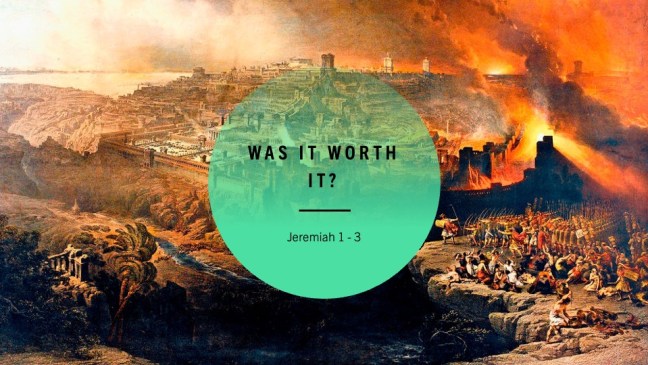
Was It Worth It?
Today’s Passage – Lamentations 1 – 3 (Click on the references to listen to the audio – click here to view the text from the Blue Letter Bible website)
(Second Milers also read – 1 Corinthians 5 – 8; Psalms 136 – 140; Proverbs 29)
Listen to this morning’s Scripture song – Deuteronomy 32:4
Read the “0829 Evening and Morning” devotion for today, by the late Charles Haddon Spurgeon.
Read a previous post from this passage – “Great Is Thy Faithfulness.“
“1 How doth the city sit solitary, that was full of people! how is she become as a widow! she that was great among the nations, and princess among the provinces, how is she become tributary! 2 She weepeth sore in the night, and her tears are on her cheeks: among all her lovers she hath none to comfort her: all her friends have dealt treacherously with her, they are become her enemies. 3 Judah is gone into captivity because of affliction, and because of great servitude: she dwelleth among the heathen, she findeth no rest: all her persecutors overtook her between the straits. 4 The ways of Zion do mourn, because none come to the solemn feasts: all her gates are desolate: her priests sigh, her virgins are afflicted, and she is in bitterness. 5 Her adversaries are the chief, her enemies prosper; for the LORD hath afflicted her for the multitude of her transgressions: her children are gone into captivity before the enemy. 6 And from the daughter of Zion all her beauty is departed: her princes are become like harts that find no pasture, and they are gone without strength before the pursuer. 7 Jerusalem remembered in the days of her affliction and of her miseries all her pleasant things that she had in the days of old, when her people fell into the hand of the enemy, and none did help her: the adversaries saw her, and did mock at her sabbaths. 8 Jerusalem hath grievously sinned; therefore she is removed: all that honoured her despise her, because they have seen her nakedness: yea, she sigheth, and turneth backward.” (Lamentations 1:1-8)
“All that pass by clap their hands at thee; they hiss and wag their head at the daughter of Jerusalem, saying, Is this the city that men call The perfection of beauty, The joy of the whole earth?” (Lamentations 2:15)
As the name implies, the Book of Lamentations is a very sad book. Though the book is anonymous, it contains many similarities to Jeremiah and was likely written by him after the city of Jerusalem was completely destroyed by the Babylonians, and many of its citizens were either dead or taken into captivity. It was a very sad time and the people were certainly lamenting and morning over all that was lost (Lamentations 2:5). Each of the five chapters are poems and according to Charles Ryrie: “The first four chapters are written in what is called “limping meter,” a cadence used in funeral dirges, and thus most appropriate for this lament over the destruction of Jerusalem.”[1] These first four chapters are also Hebrew acrostics where each verse successively begins with a word whose first letter is one of the twenty-two letters of the Hebrew alphabet. Chapter three contains sections of three verses with each of the twenty-two letters, thus it has sixty-six verses total.
Jerusalem had been destroyed, but not without warning from God. The prophets, including Jeremiah, had all foretold of a day that would come when God would judge His people for their wickedness if they did not repent. The Book of Jeremiah is full of examples where the people of Judah ignored the warnings of Jeremiah (see Jeremiah 7 and 26). They were content to continue to do their thing. Idolatry was everywhere and the people were given over to drunkenness and immorality.
My question is this: was it worth it? The people refused to heed the warnings, and calamity eventually came. God was very patient with them and warned them repeatedly but they would not listen. Maybe the people thought that God did not mean it, sort of like the parent that warns his child repeatedly by saying, “if you do that one more time,” but after many more infractions there is still no penalty. God is not like a human parent, however, and judgement finally came, just as God had warned them.
But was the crime worth the penalty? I would be willing to bet that those that survived the calamity and subsequent captivity would all agree that it was not.
This passage is about Judah and the captivity that came because of their sin and continued rejection of the Lord, but let’s make application to today. Maybe you are dabbling with some sin, and maybe you are doing your thing, ignoring what you know God wants you to do. Perhaps judgement (God’s correction) is on its way for you as well. When calamity comes into your life, you will probably be like the Israelites of old who regretted the fact that they did not listen to God.
Maybe you are reading this blog and you have never trusted Christ as your Savior. Here is your warning. You need to turn to Christ in repentance and faith before it is eternally too late. Note – See the “Are You Saved” tab at the top of this website for more information about salvation.
Maybe you are already saved but you are not living your life in submission to the will of God. Well, you don’t have to worry about going to Hell because your sins are all forgiven as far as eternity is concerned, and praise God for that. However, you can expect correction from the Lord if you do not yield to what He wants for you (Job 5:17; Proverbs 3:12; Hebrews 12:7 – 11). Believe me, the pain of the correction will outweigh the fun of doing your own thing. God took away just about everything from the people of Judah. What will he have to take away from you to get your attention?
[1] Charles Caldwell Ryrie, Ryrie Study Bible: King James Version, Expanded ed. (Chicago: Moody Press, 1994), 1173.
Posted in Devotions by Phil Erickson with 1 comment.
I Will Pardon Them Whom I Reserve

Today’s Passage – Jeremiah 51 – 52 (Click on the references to listen to the audio – click here to view the text from the Blue Letter Bible website)
(Second Milers also read – 1 Corinthians 1 – 4; Psalms 131 – 135; Proverbs 28)
Listen to this morning’s Scripture song – 1 John 4:7 & 8
Read the “0828 Evening and Morning” devotion for today, by the late Charles Haddon Spurgeon.
Read a previous post from this passage – “Are You Still in Prison”
“18 Therefore thus saith the LORD of hosts, the God of Israel; Behold, I will punish the king of Babylon and his land, as I have punished the king of Assyria. 19 And I will bring Israel again to his habitation, and he shall feed on Carmel and Bashan, and his soul shall be satisfied upon mount Ephraim and Gilead. 20 In those days, and in that time, saith the LORD, the iniquity of Israel shall be sought for, and there shall be none; and the sins of Judah, and they shall not be found: for I will pardon them whom I reserve.” (Jeremiah 50:18-20)
Beginning in chapter 47, God is pronouncing judgment through the prophet Jeremiah on all the nations that had been an enemy to God’s people: Philistia (ch. 47), Moab (ch. 48), Ammon, Edom, Damascus, Cedar, Hamon, and Elam (ch. 49). In chapters 50 – 51, the focus of God’s judgment is on Babylon. Again, the judgment described in these chapters seems to surpass the conquering of the Babylonians by the Medes and Persians, which seemed to have happened without much of a fight (see Daniel 5). The description given in these chapters depict the future destruction of Antichrist’s kingdom in Revelation 17 and 18.
Interestingly, chapter 52 goes back in time and discusses the Babylonian siege against Jerusalem, which culminated in 586 BC. It is another historic interlude similar to one we saw in chapter 39. This one reads almost identically to 2 Kings 24:18 – 25:30.
My thought this morning is that though God used Babylon as an instrument of judgment against Israel, which is what the majority of this Book of Jeremiah has been focused on, He will still judge Babylon for what she did to God’s people. God allows and even uses evil people to accomplish His will in the lives of those that belong to Him, but we must not ever make the mistake of confusing God’s chastisement of His own with His ultimate wrath upon those who do not belong to Him.
I remember when I was a boy, my brothers and I used to fight like cats and dogs, but there was never a time when anybody outside of my family could ever attack me without experiencing the wrath of my older brothers. My brothers felt like they could whip up on me all they wanted, but they were not about to let anybody else touch me. That may be a weak illustration but it somewhat pictures God’s dealings with Israel. God would allow a certain measure of punishment to come Israel’s way but He would never allow them to be completely destroyed. However, the nations, like those listed above and in chapters 47 – 51, had no such guarantee. God ultimately destroyed (or will destroy) these nations that had oppressed Israel.
What is the application for us today? If you belong to God, you are in His hands and no-one can pluck you out of God’s hands. Absolutely nothing bad can happen to you unless God for some very good reason wills it to happen. Nothing gets past the desk of God. He sees everything that is happening in your life. I am reminded of what Satan told God in the Book of Job: “10 Hast not thou made an hedge about him, and about his house, and about all that he hath on every side? thou hast blessed the work of his hands, and his substance is increased in the land” (Job 1:10). How did Satan know that God had hedged Job in on every side? He must have been trying to get in, but God wouldn’t let him. It is the same way with us. Satan can only do what God permits him to do to us, and the same principle applies to all our enemies. Israel had to be chastised for their rebellion against God, but God never forsook them, and He still has a wonderful plan for them. He has a wonderful plan for you as well. Notice Jeremiah 50:20 above. God sees Israel without iniquity and completely pardoned; and if you belong to God, that is how He sees you as well.
Notice what Spurgeon said about v. 20: “Those sins were of no common order. The Israelites were always a stiff-necked and rebellious race. Israel’s sins were of the most heinous character because of the greatness of their privileges and the peculiar and special love the Lord had lavished on them. They were positively unmatched in guilt by any nation under heaven. For all of that, the Israelites cast away their God. They who had worshiped the Lord turned aside from him and bowed down before Baal and went after other gods and worshiped idols. But their provocations, their idolatries, their lusts were all to be swept away and to be forgotten.” (Spurgeon. 2017. The Spurgeon Study Bible: Notes. Nashville, TN: Holman Bible Publishers).
We all deserve the judgment and destruction that Babylon received (and will receive in the future), but God in His marvelous grace has pardoned those who have placed their faith in Him. What an awesome God we serve!
Posted in Devotions by Phil Erickson with 2 comments.
Seekest Thou Great Things for Thyself?

Today’s Passage – Jeremiah 41 – 45 (Click on the references to listen to the audio – click here to view the text from the Blue Letter Bible website)
(Second Milers also read – Romans 5 – 8; Psalm 119; Proverbs 25)
Listen to this morning’s Scripture song – *James 4:10*
Read the “0825 Evening and Morning” devotion for today, by the late Charles Haddon Spurgeon.
Read a previous post from this passage – The Safest Place on Earth
“Thus shalt thou say unto him, The LORD saith thus; Behold, that which I have built will I break down, and that which I have planted I will pluck up, even this whole land. And seekest thou great things for thyself? seek them not: for, behold, I will bring evil upon all flesh, saith the LORD: but thy life will I give unto thee for a prey in all places whither thou goest.” (Jeremiah 45:4-5)
Baruch was Jeremiah’s assistant. We find him assisting Jeremiah in the purchasing of land in chapter thirty-two, and again in chapter thirty-six we see Baruch performing the role of an amanuensis, recording the words of Jeremiah, which he then read before the king to warn him of the judgment that God had pronounced upon Judah. Baruch was a faithful servant of the Lord and helper to Jeremiah, but in chapter forty-five, Baruch is complaining about the hardships that he is facing in life because of all of the bad stuff that is happening in the kingdom:
“Thou didst say, Woe is me now! for the LORD hath added grief to my sorrow; I fainted in my sighing, and I find no rest.” (Jeremiah 45:3)
God tells him through the prophet Jeremiah that a lot of horrible stuff is about to happen to the people of God and a great number of people are going to die, and this is not the time for Baruch to be looking for some great reward or a life of ease. God tells him to just be thankful that he was going to escape the judgment with his life intact. Baruch should have been more concerned about how much his nation had fallen from God and how their sin grieved the Lord. Baruch was looking for an “attaboy” because he was still holding the line and being faithful, but it was not a time for pleasure and rejoicing; it was a time of great calamity for his nation. Baruch was going to get to live and he should be content with that.
Here’s an application that I think can made from this passage. We all have certain expectations about how life could (and maybe should) be. We have this idea that if we do right we can expect to live an easy life, be blessed with a loving family and good friends, have a house with a white picket fence, enjoy good health, and live a long time on the earth. However, as God’s people, our purpose for living here does not surround us and our desires, it surrounds the will of God. We are here on this earth to glorify Him, communicate the gospel to the lost world around us, and to serve other people. God may and will bless us with many good things, and if we are faithful, we will certainly receive many rewards in Heaven. However, we need to learn to be content with whatever God wills and allows for us in this life, and sometimes God permits some “bad” stuff to happen to His children.
The apostle Paul was one of the greatest servants of God in the first century, but he didn’t enjoy here on earth many of the things that the average American Christian expects today. He was beaten often for his faith and put in prison countless times, but he was content with whatever the Lord allowed in His life:
“Not that I speak in respect of want: for I have learned, in whatsoever state I am, therewith to be content. I know both how to be abased, and I know how to abound: every where and in all things I am instructed both to be full and to be hungry, both to abound and to suffer need. I can do all things through Christ which strengtheneth me.” (Philippians 4:11-13)
As Christians, we do not live for ourselves, we live for the Lord. We serve Him. Will He take care of us and supply our needs? Yes. Will he even bless us with many good things that we will be able to enjoy while we are here on earth? Yes. But, he may also allow, or even ordain, some hardship that we must endure according to His will, and we must be content with that. Really, we must learn to be content with Him and with whatever He puts into our lives.
“For to me to live is Christ, and to die is gain.” (Philippians 1:21)
“But godliness with contentment is great gain. For we brought nothing into this world, and it is certain we can carry nothing out. And having food and raiment let us be therewith content. But they that will be rich fall into temptation and a snare, and into many foolish and hurtful lusts, which drown men in destruction and perdition.” (1 Timothy 6:6-9)
Posted in Devotions by Phil Erickson with 4 comments.